
Defense additive manufacturing becomes useful when an organisation can identify a suitable part, access an approved production package and manufacture an acceptable result within its operating constraints. Polymer printers, metal systems and deployable production cells each contribute to that capability, but they require different support and qualification arrangements.
MSPO 2026 took place in Kielce, Poland, from 8–11 September 2026. Omni3D’s event programme brought together polymer and metal additive manufacturing with the TFU20 point-of-need production concept. After the exhibition, the practical next step is to evaluate how those elements fit a defined maintenance or manufacturing requirement.
Building a defense additive manufacturing architecture
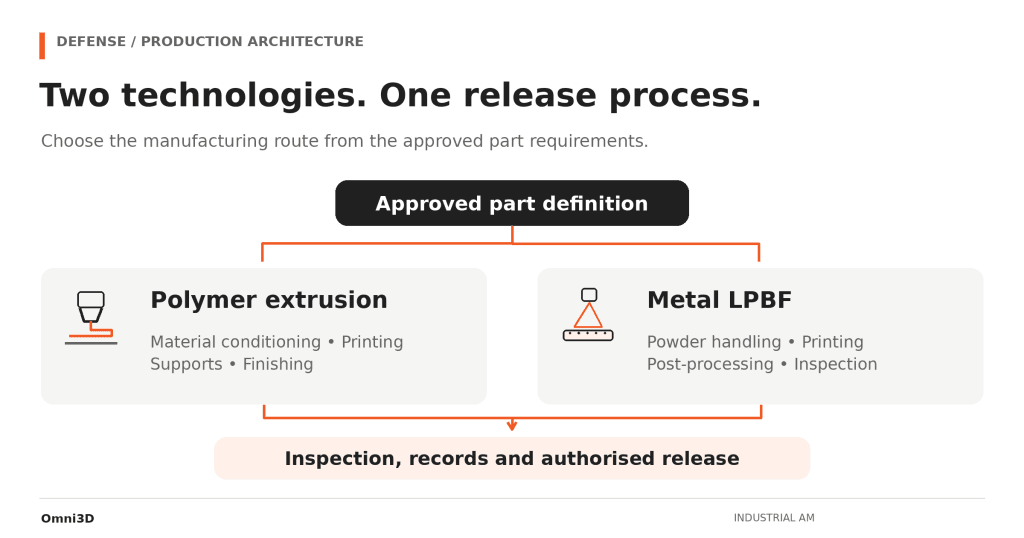
Start with the task, then choose the process. Assembly aids, inspection fixtures, protective covers and selected replacement parts have different requirements for stiffness, wear, temperature, fit and traceability. A material change must be assessed against those requirements, especially when replacing an existing metal component.
Polymer material extrusion and laser powder bed fusion (LPBF) offer complementary routes. They should share an approved part definition and release process, while retaining their own material handling, production and inspection procedures.
| Production route | Typical evaluation focus | Supporting operations |
|---|---|---|
| Polymer material extrusion | Geometry, orientation, material grade and working environment | Material conditioning, supports, finishing and dimensional checks |
| Metal LPBF | Alloy, machine configuration, build strategy and acceptance requirements | Powder handling, support removal, treatment and inspection as required |
| Point-of-need production cell | Deployable capacity, approved workload and local resources | Power, environmental control, trained staff, maintenance and records |
Polymer systems: qualify the material and the application
The Omni PRO and Omni PRO HT platforms address different thermal-processing requirements within industrial polymer manufacturing. Omni PRO HT is specified with an actively heated chamber up to 220°C and a print-head temperature up to 500°C. These are equipment limits, not universal settings or finished-part service temperatures.
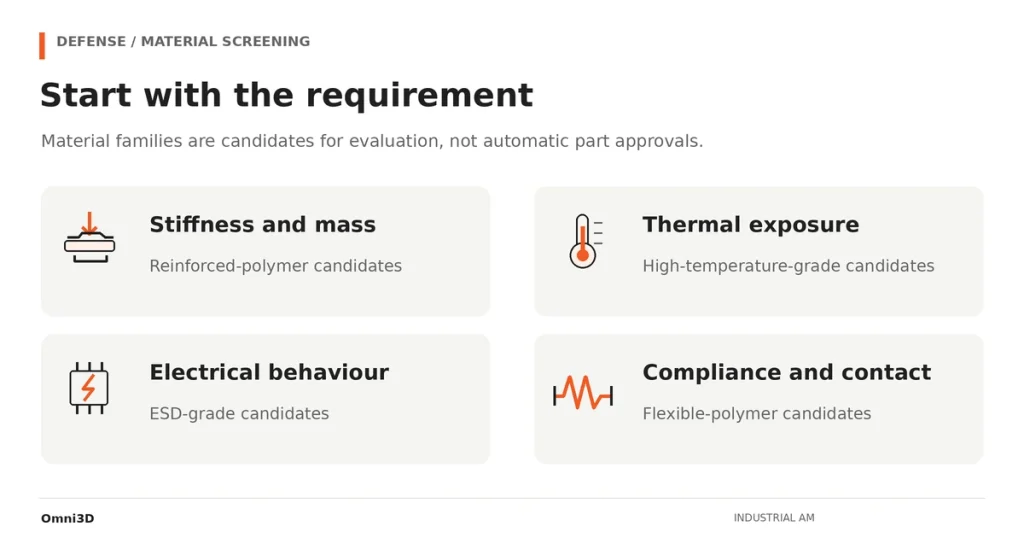
Evaluate material families against the operation. A reinforced polyamide may be considered for a stiff fixture body; an ESD grade for an electronic handling application; a flexible polymer for a compliant contact; and a high-temperature grade where thermal exposure requires it.
Each candidate needs evidence for the exact grade and printed configuration. Mechanical, electrical, chemical and fire-performance requirements should be addressed separately. A material name does not establish that the final component has been approved for a defense platform.
Metal systems: plan the complete route
The Omni M150 and Omni M280 portfolio provides LPBF options at different scales. System selection should follow the part envelope, alloy, build strategy and required production capacity.
The process plan extends beyond printing. It may include powder preparation and recovery, removal from the build plate, heat treatment, machining and inspection. Define which steps take place locally and which rely on another qualified facility.
Do not assume that presenting polymer and metal equipment within one portfolio means every deployable cell contains both. The selected configuration and supporting infrastructure determine what can actually be produced at a given location.
TFU20: define the production boundary
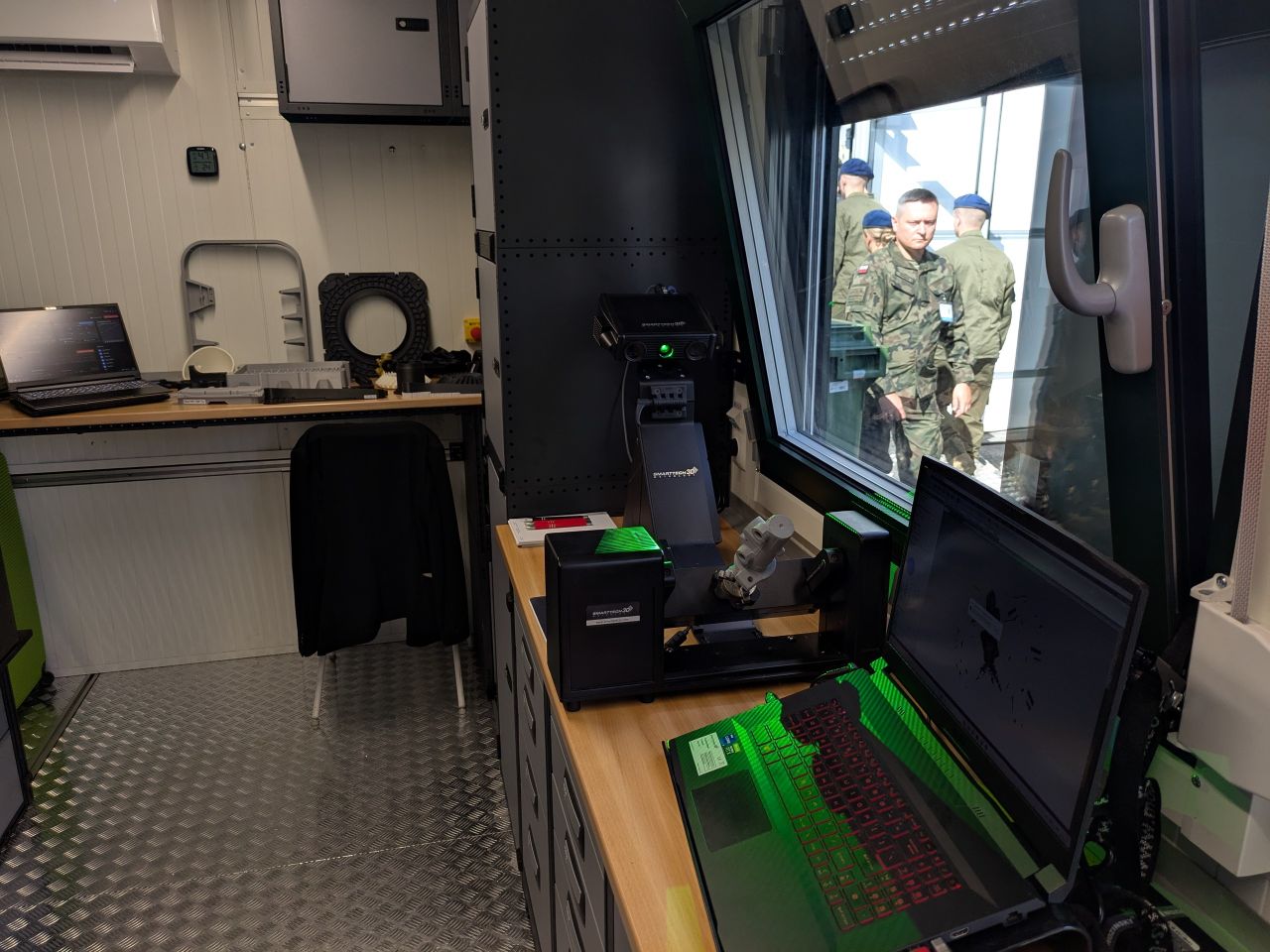
Omni3D’s Tactical Fabrication Unit, TFU20, is a containerised production concept built around a 20 ft shelter. Its value is the possibility of organising a production workflow closer to the point of need.
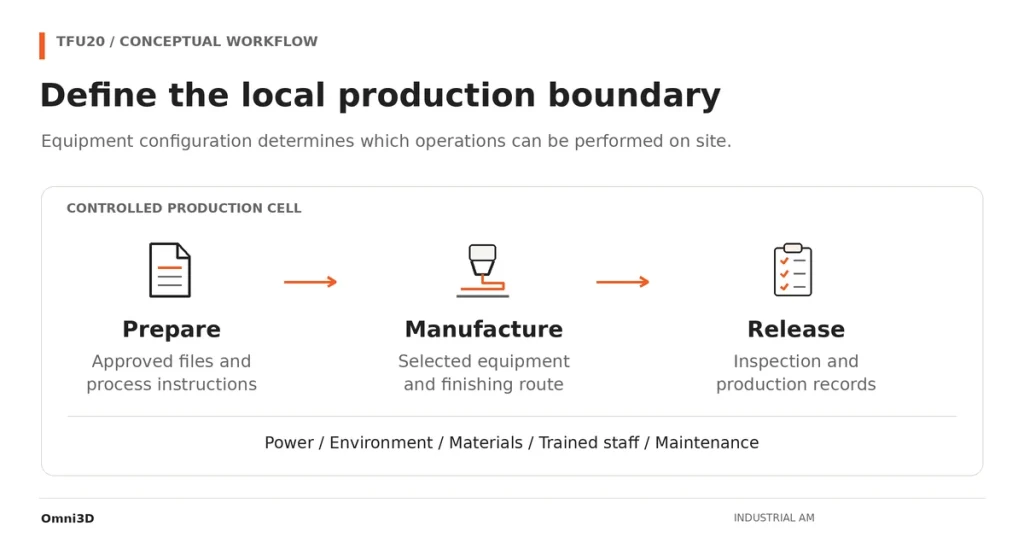
A deployment assessment should cover the available power, environmental conditions, material storage, equipment access and maintenance arrangements. Identify the printing and finishing operations the cell must support, then match the selected equipment to those tasks.
The workflow can be organised around three connected activities: controlled preparation of the digital package, local manufacturing and finishing, and inspection with authorised release. The associated records should allow the organisation to identify what was made, from which file and material, using which configuration.
Digital inventory can reduce dependence on selected stocked items. It still needs physical material, consumables, replacement machine parts, staff and enough time to complete and inspect the build. Keep those dependencies visible in the logistics plan.
Control data and release authority
An approved CAD file is only part of the production package. Drawings, process instructions, material requirements, inspection criteria and configuration records may also be needed.
Define who can change that package and who can authorise use of the resulting component. Manage file transfer, removable media, network connections and maintenance access as part of the production environment. Omni3D’s guide to secure additive manufacturing for defense provides a framework for those questions.
For supplier identification, Omni3D is NCAGE-listed under code 9BT1H. NCAGE identifies an organisation within the NATO Codification System; it is not a blanket certification of a printer or printed part.
Assess operational value with a representative workload
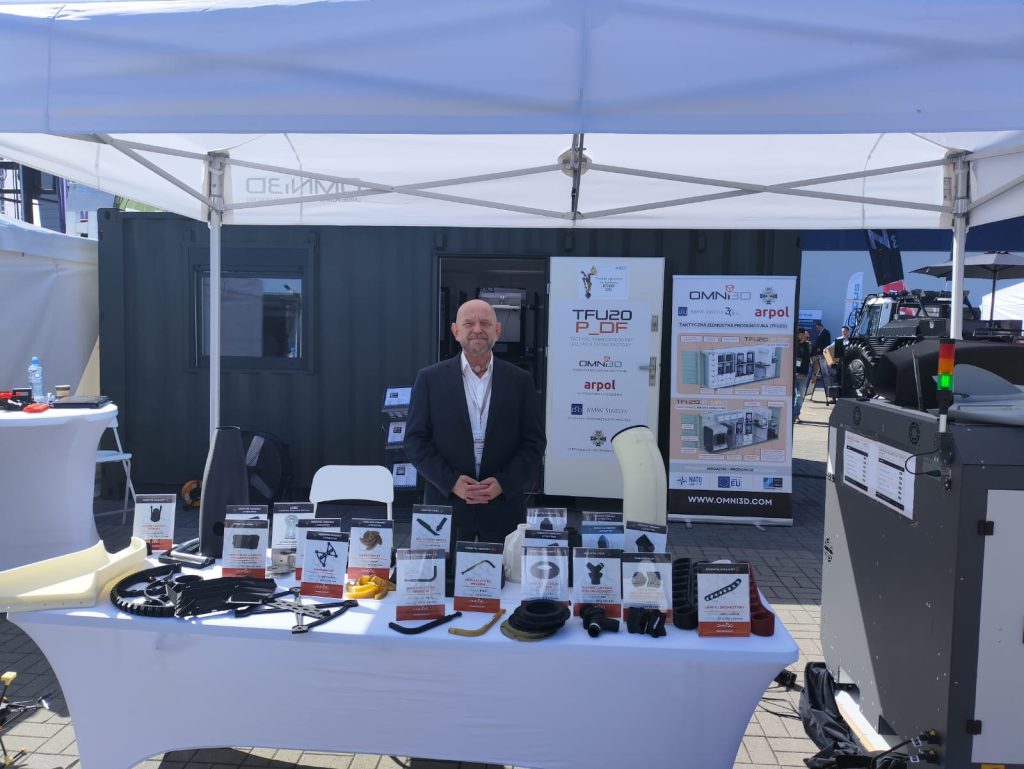
Choose parts with a clear need and a manageable qualification route. Compare the existing supply process with the full additive route, including preparation, printing, finishing, inspection and release. Measure accepted-part cost and elapsed delivery time on a like-for-like basis.
Potential benefits include quicker access to a specific tool, the ability to respond to an engineering change or a practical route for an otherwise difficult-to-source part. Their value depends on the actual workflow and should be demonstrated through the evaluation.
Evaluate your project with an Omni3D expert. Review the candidate parts, operating environment, material requirements and TFU20 configuration options to define a realistic production and qualification plan.







