
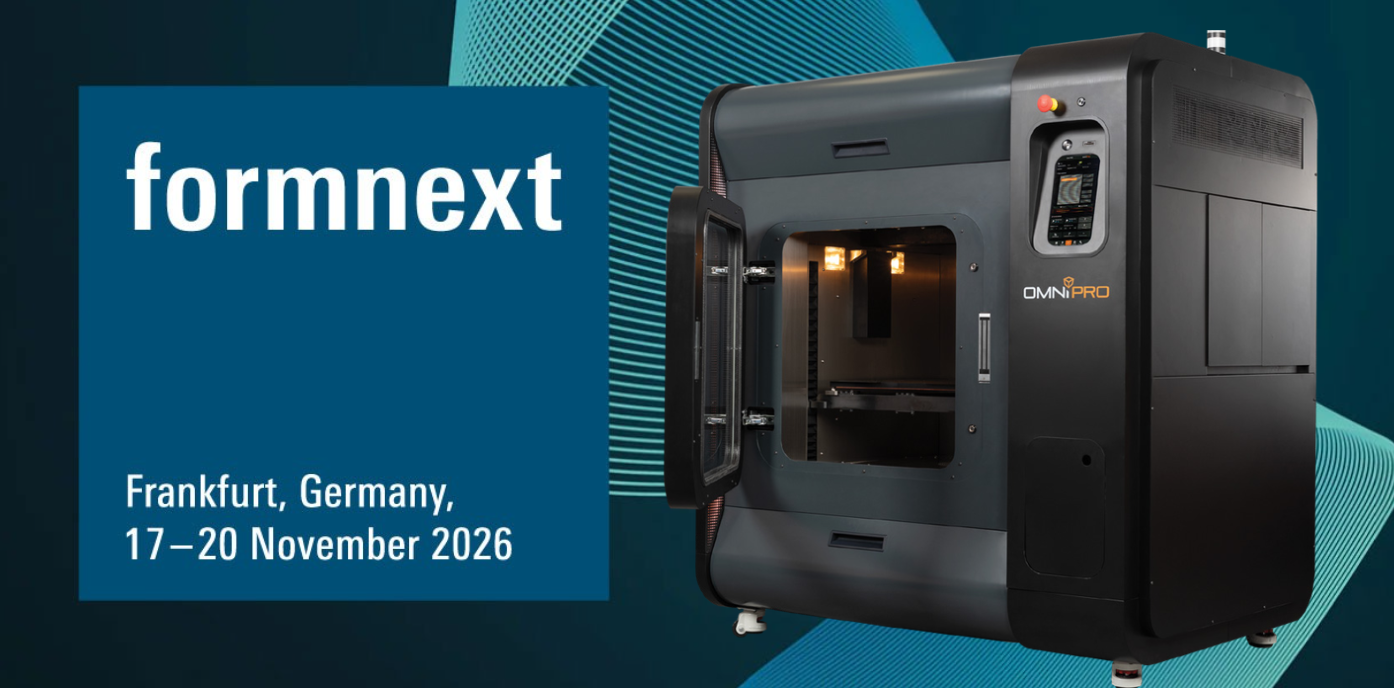
Formnext 2026 is an opportunity to turn manufacturing questions into a focused plan for the next stage of production. For Omni3D, exhibiting is also a chance to listen: to understand where factories need greater capacity, where materials limit an application and where a workflow still consumes too much engineering time.
Meet Omni3D at Hall 12.1, Booth F41, during Formnext in Frankfurt am Main, Germany, from 17–20 November 2026.
Why make time for Formnext 2026?
Daily production leaves little room for stepping back. Orders need attention, equipment needs maintenance, parts need inspection and engineering changes cannot always wait. Those demands are real, but they can make it difficult to examine how the operation should develop.
A trade fair becomes useful when the team arrives with specific questions. Which task takes too much operator time? Which component is hard to source? Which new application would justify a different material or production process?
Those are the conversations Omni3D wants to have at Formnext. The aim is to connect industrial additive manufacturing with work that needs to be done, then identify what evidence would support the next decision.
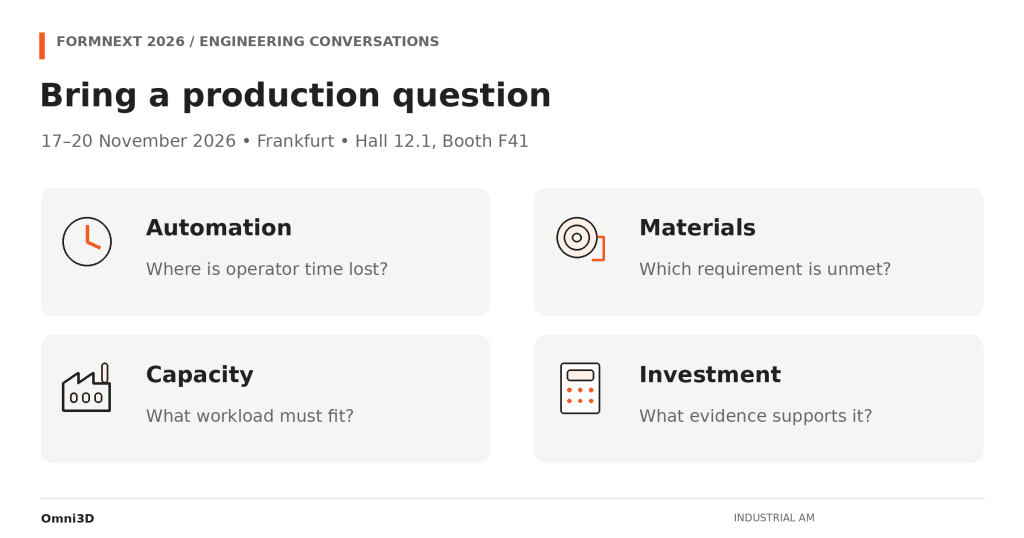
Four questions to bring to the exhibition
Where would automation remove a real bottleneck?
Look beyond the printing cycle. File preparation, material changes, part removal, finishing and inspection can each affect delivery time. A faster machine may have limited value if another stage controls the output.
Describe the current workflow and identify which tasks consume active operator time. Then ask what a proposed automated step would change, what it would require and how it would fit into the existing production environment.
Which material would open a useful application?
New material capability matters when it meets a requirement that the current process cannot address economically or reliably. Start with the component’s loads, temperature exposure, contact conditions and expected life.
The Omni3D polymer materials portfolio provides a starting point for that discussion. For higher-temperature processing, the Omni PRO HT offers a platform to evaluate against the material and application requirements. The objective is a suitable, reproducible process for the selected grade.
What capacity is actually needed?
Define the expected workload in terms of part families, geometry, production frequency and required delivery dates. Include the time needed for preparation, finishing and inspection.
Polymer material extrusion and metal LPBF address different requirements. Keeping those routes distinct makes it easier to identify which equipment, facilities and skills a factory would need. It also helps decide which work should remain with a specialist service provider.
What evidence would justify the investment?
A useful evaluation should end with a testable next step. That might be a sample built to an agreed drawing, a comparison with an existing tool or a cost model based on a realistic workload.
Record the acceptance criteria before beginning the trial. Include the effort needed to produce an accepted part, and distinguish measured results from assumptions about future demand.
Bring one manufacturing challenge
You do not need a complete investment plan to start the discussion. Bring a component, a drawing or a concise description of the bottleneck, together with the requirements you already know.
For applications still at an early stage, Omni3D engineering and 3D printing services can help frame the evaluation before a machine purchase is considered. For established workloads, the discussion can focus on configuration, process transfer and production planning.
The value of attending extends beyond a list of new technologies. A productive visit should leave the team with a clearer question, a relevant contact and an agreed way to test what comes next.
Arrange a meeting with Omni3D at Formnext 2026. Visit Hall 12.1, Booth F41, and bring the manufacturing challenge you want to explore.







