
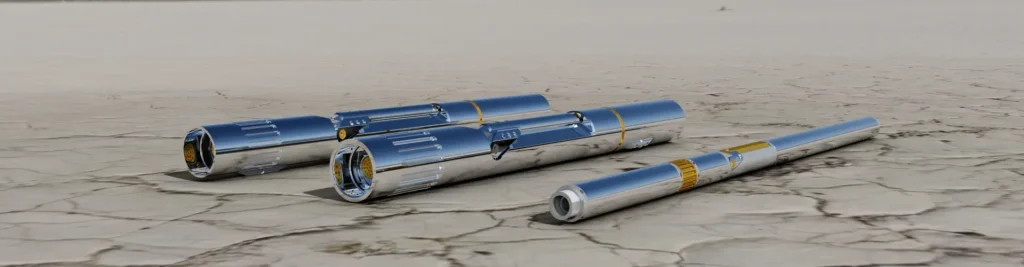
A downhole thermal barrier must be designed around its operating environment and manufactured with a process suited to the selected polymer. For Avalon Sciences, a UK borehole seismic technology company, developing this component involved evaluating both PEEK printing and a PEKK-A manufacturing route with Omni3D.
The project illustrates a practical challenge in oil and gas additive manufacturing: choosing a high-performance material is only the beginning. Machine capability, printing parameters and component testing must work together before a part can be considered suitable for service.
The challenge: a thermal barrier for demanding downhole conditions
Avalon Sciences approached Omni3D for support with a thermal barrier intended for downhole tools operating in environments exceeding 200°C. The original material requirement was PEEK, a high-performance thermoplastic selected for its combination of thermal and mechanical properties.
Initial attempts to manufacture the component on Avalon’s Factory 2.0 had proved difficult. The team needed guidance on a printing route that could address the material’s processing demands and provide a component for further evaluation.
For this application, printability and service performance were separate engineering questions. Producing the geometry would enable assessment of the component, while suitability for the downhole environment depended on the finished part meeting the application’s thermal and functional requirements.
Assessing the machine and material together
Omni3D recommended considering the Omni PRO HT for the PEEK manufacturing route. The recommendation focused on matching the equipment to the polymer’s processing requirements, rather than treating the existing printer as interchangeable with a system intended for more demanding thermal conditions.
In parallel, Omni3D proposed PEKK as an alternative route for evaluation. PEEK and PEKK belong to the polyaryletherketone family, but they are distinct materials. Selecting one in place of the other requires consideration of the specific grade, manufacturing process and intended operating conditions.
This gave the project two clearly defined paths: continue developing the PEEK solution for the original requirement, and assess a separately specified PEKK-A option. The alternative offered a way to explore manufacturing feasibility without assuming that the two polymers would deliver identical performance.
The GSR-38 PEKK-A manufacturing proposal
Omni3D’s quotation dated 3 April 2024 defined a manufacturing configuration for one GSR-38 component using PEKK-A from Kimya on the Omni PRO. This proposal provides a concrete view of the process configuration considered for the PEKK-A route.
| Parameter | Quoted configuration |
|---|---|
| Component | GSR-38 |
| Quantity | 1 |
| Printer | Omni PRO |
| Technology | Fused filament fabrication (FFF) |
| Build material | PEKK-A (Kimya) |
| Support material | PEKK-A (Kimya) |
| Nozzle diameter | 0.40 mm |
| Wall thickness | 0.96 mm |
| Layer height | 0.20 mm |
| Infill pattern | Honeycomb |
| Infill amount | 20% |
The quotation specified a maximum completion time of two weeks, with manufacturing to begin after acceptance of the offer. The same PEKK-A material was specified for both the component and its supports, making support access and removal part of the manufacturing plan.
These parameters describe the quoted GSR-38 build. They are specific to this proposal and provide a starting point for assessing geometry, surface condition and the next stages of component evaluation.
From a manufacturing route to component evaluation
The value of the collaboration was a clearer route through a difficult material-processing problem. Avalon could evaluate a documented PEKK-A proposal while discussing the equipment and support required for the original PEEK requirement.
For a thermal barrier, evaluation must connect the printed geometry to its intended role in the tool assembly. Dimensional fit, the effects of support removal and behaviour under the relevant thermal conditions all matter when deciding whether a manufacturing route is appropriate.
A successful build is therefore one step in the development process. The next step is to assess the finished component against the application requirements, using the selected material grade and the actual manufacturing configuration.
What the project shows about oil and gas additive manufacturing
The Avalon project highlights the importance of treating material selection, equipment capability and process planning as a connected engineering task. A polymer’s name alone does not define the performance of a printed component, and a machine recommendation should be tied to the particular application.
It also shows how external printing support can complement in-house equipment. When a component exceeds the practical processing capabilities of an existing system, a specialist manufacturing proposal helps a team assess another route before committing to changes in equipment or production strategy.
For low-volume, demanding components, this approach can make development more structured: define the service requirement, select the material and machine combination, document the build configuration, and evaluate the finished part.
Discuss your high-temperature component with Omni3D
If your team is developing a thermal barrier or another demanding polymer component, share the geometry, operating conditions and material requirements with Omni3D. These inputs help establish an appropriate printing route and the evaluation steps needed for the application.
Request a technical assessment from Omni3D to discuss your component and manufacturing requirements.




