

This case study demonstrates how automotive tooling validation can be improved through large-format 3D printing before committing to expensive composite mold production.
The Challenge: Tooling Capitalization Risk in Composite Molding
An international automotive composites manufacturer in Thailand, specializing in fiber-reinforced composite parts for public transit buses and electric tuk-tuks, faced high scrap rates and extended lead times during the mold-commissioning phase. In the fiber-composites sector, machining or laying up a mold based solely on CAD models presents a major operational risk. Any undetected geometric deviation, volumetric mismatch, or assembly-clearance error results in immediate tool failure, scrapping both expensive tooling materials and hundreds of engineering hours.
To eliminate this vulnerability, the manufacturer required a reliable method to produce full-scale, dimensionally stable physical models to confirm part fit, ergonomics, and geometric assembly directly on vehicle chassis before finalizing tooling.
The Solution: Thermal Control and Calibrated Extrusion via Omni TECH+
The manufacturer integrated the Omni TECH+ large-format industrial system into their pre-production workflow. The primary objective was to print a 1:1 scale operational prototype of an electric tuk-tuk front wheel cover (fender) component.
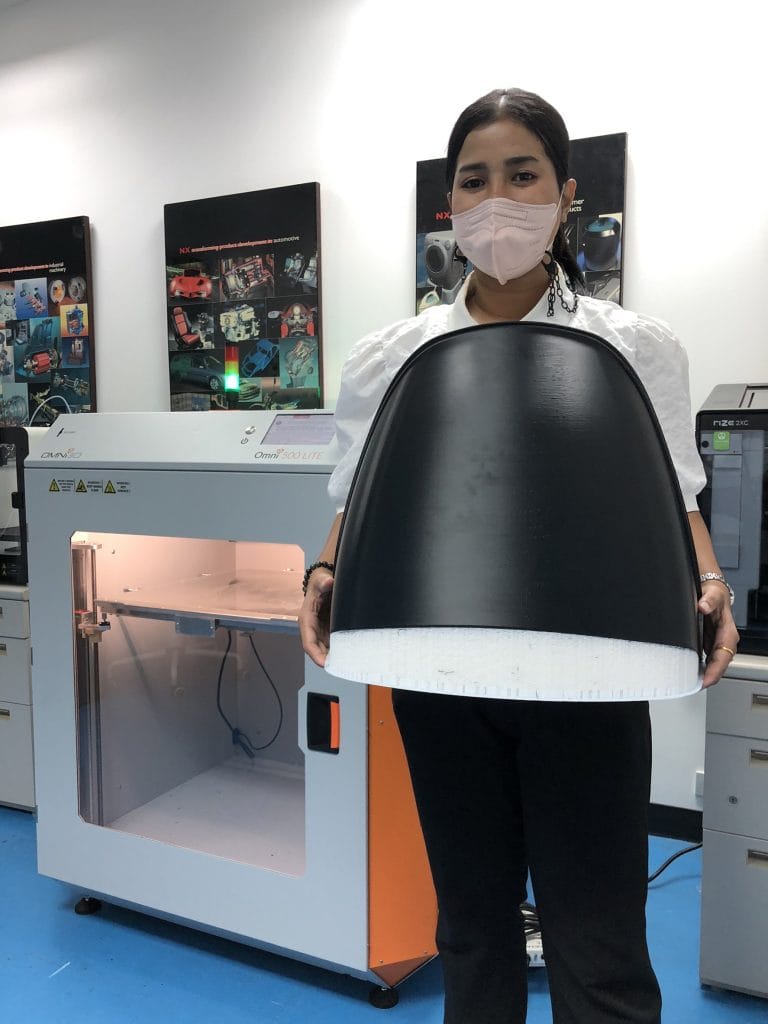
For a print volume of this scale (436×391×400 mm), managing the material’s Coefficient of Thermal Expansion (CTE) is critical to preventing print failure. As high-performance and industrial thermoplastics cool, internal crystallization and thermal contraction stresses pull the part’s corners upward, causing warpage and delamination.
The Omni TECH+ system mitigates this via an integrated, actively managed heated build chamber maintained at a stable 80°C, combined with a print bed heated to 100°C. This controlled thermal environment keeps the deposited material above its glass transition temperature (Tg) longer, allowing internal residual stresses to relax and ensuring excellent interlayer adhesion.
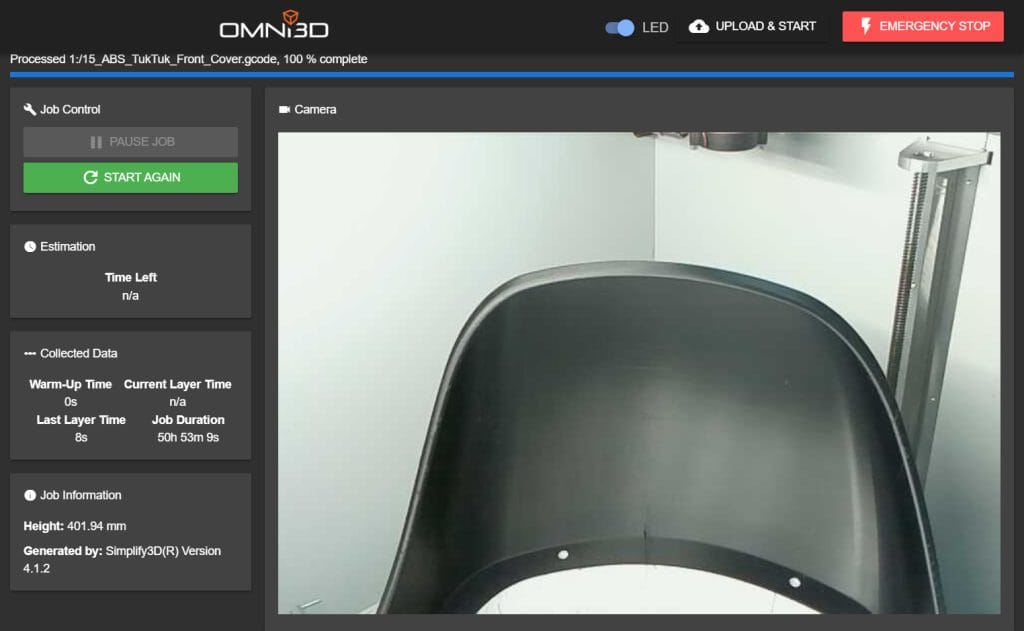
To further ensure process stability and prevent first-layer detachment under high shear forces, the build plate was prepared with ASNARE Universal First-Layer Adhesion (UFA) polymer adhesive. This laboratory-validated chemical bond anchors the footprint of the large component to the bed throughout the 50-hour print cycle.
Material Strategy and Extrusion Metrics
The component was printed using an industrial-grade ABS-42 material, supported by a HIPS-20 breakaway support structure. This combination balances mechanical rigidity with a clean breakaway surface finish along overhang zones. Leveraging Omni3D’s ecosystem of 40+ manufacturer-approved, preset print profiles, process engineers eliminated the trial-and-error optimization typically required by open-material systems. The part was sliced with a 25% rectilinear infill and 2 outline perimeters to optimize the strength-to-weight ratio for functional garage handling.
| Parameter | Industrial Operational Specification |
| System Hardware | Omni TECH+ (Industrial Large-Format Platform) |
| Material Formulation | ABS-42 (Primary) / HIPS-20 (Breakaway Support) |
| Part Dimensions | 436×391×400 mm |
| Linear Print Velocity | 100 mm/sec |
| Infill Architecture | 25% Volumetric Density, Rectilinear Geometry |
| Perimeter Boundary | 2 Outlines (Contours) |
| Total Build Duration | 50 Hours (Continuous, Monitored) |
| Thermal Profiles | Nozzle: 250°C | Bed: 100°C | Chamber: 80°C Active |
Documented Operational Outcomes
By validating the front wheel cover prototype on physical chassis fixtures before manufacturing the composite molds, the factory achieved complete geometric confirmation.
“Currently, we work with fiber composites for the automotive industry, vehicles like buses, tuk-tuks, and various automotive parts. Since we brought in OMNI3D to make our prototypes, it has provided us with high precision and made our work easier. And most importantly, it helps reduce costs and time significantly.” Khun Monthatip Kongcharun, Factory Director and Automotive Composites Entrepreneur







