
Here’s what actually drives ROI in polymer additive manufacturing and where most vendors mislead you: it is not the theoretical max speed of the printhead, but the predictable optimization of the build environment and custom tools and the exact material-to-application match.
When global OEMs like Volkswagen integrate additive manufacturing into continuous automotive production lines, they don’t look for generic prototypes. They require mission-critical components that endure aggressive chemical exposure and high cyclic mechanical loads. A single failure of a 3D-printed tool on an automated assembly line doesn’t just halt a print job, it disrupts the entire plant’s capacity utilization, spiking Total Cost of Ownership (TCO) through thousands of dollars per minute in unplanned downtime.
.
Industrializing the Assembly Line: How Volkswagen Leverages the OmniTECH for High-Chemical End-of-Arm Tooling
Automotive manufacturing leaves zero margin for dimensional variance or material degradation. On high-volume assembly lines, tools are continuously subjected to mechanical stress, thermal fluctuations, and corrosive production chemicals.
Historically, procuring custom end-of-arm tooling (EOAT) via traditional CNC machining or injection molding meant navigating long lead times, massive inventory overhead, and high single-unit procurement costs. Today, leading automotive plants are shifting from centralized supply chains to on-demand, factory-floor production using industrial-grade material extrusion systems like the OmniTECH.
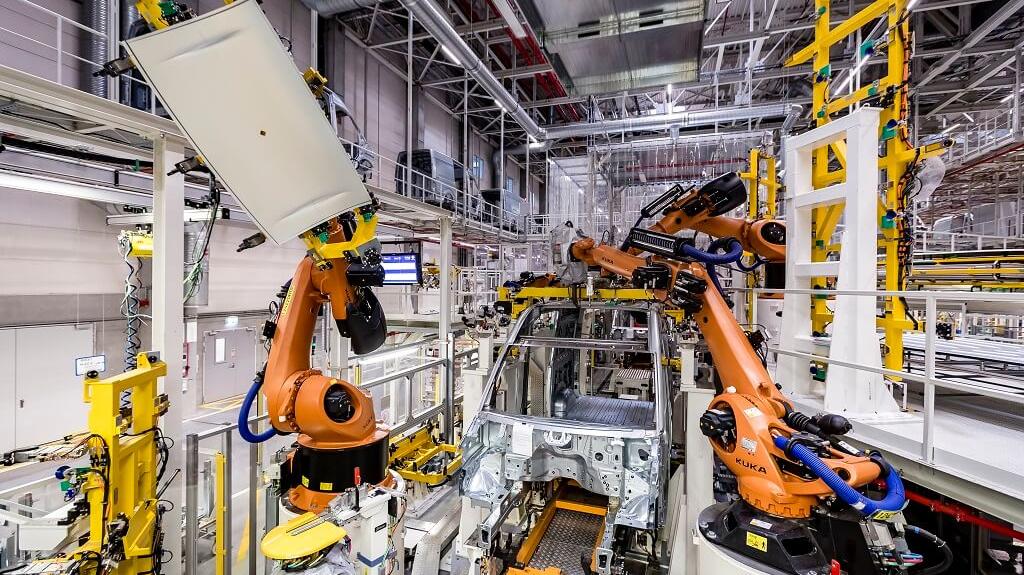
The Application: Automated Windshield Priming at Volkswagen Września
At the Volkswagen factory in Września, Poland, process engineers identified an optimization bottleneck in the vehicle window assembly stage, specifically, the application of the structural adhesive activator that bonds the glass pane to the steel chassis.
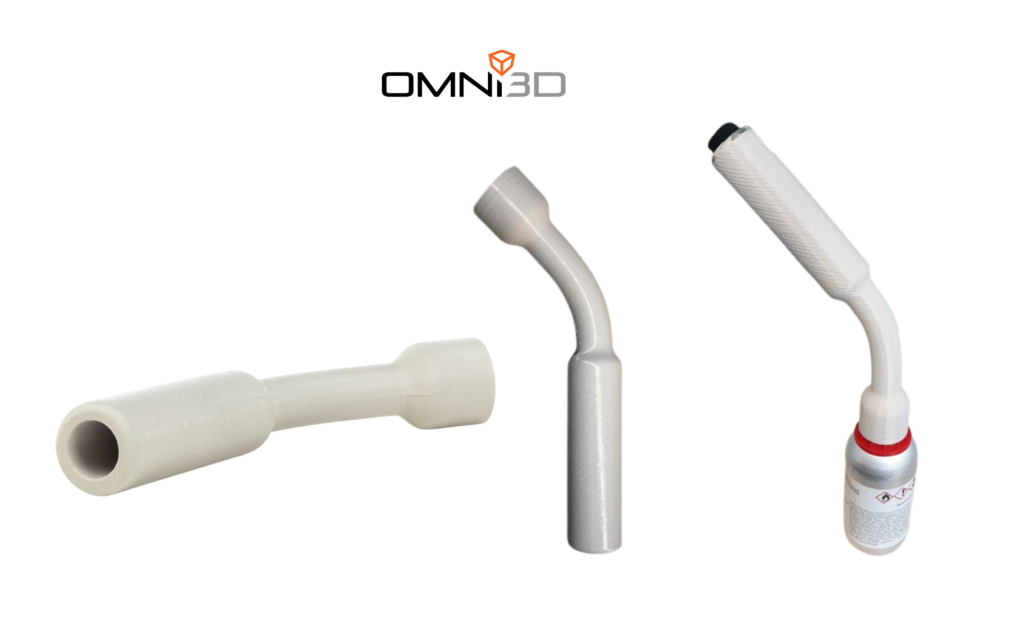
The operation utilizes synchronized robotic arms equipped with integrated vision systems. These arms track the car body along common axes, dispensing a highly reactive chemical primer from an onboard reservoir. The critical component in this automated loop is the dosing nozzle. It must match the precise kinematics of the robotic arm while maintaining a perfectly uniform fluid path to prevent inconsistent activator deposition, which would compromise glass adhesion.
Material Engineering: Why THERMEC™ ZED Defeats Standard Thermoplastics
Standard engineering filaments like ABS or unfilled Polyamides (PA) fail rapidly in this environment. The primer used in automotive glass assembly contains aggressive, corrosive volatile organic solvents designed to strip contaminants and prep surfaces. Over time, these solvents cause micro-cracking, chemical swelling, and eventual mechanical failure in low-grade polymers.
To guarantee continuous line uptime, Omni3D application engineers specified THERMEC™ ZED, an advanced, high-performance polymer explicitly tailored for harsh industrial environments.
| Technical Property | Performance Metric |
|---|---|
| Chemical Resistance | Outstanding (Solvents, Oils, Acids) |
| Thermal Profile | Flame Retardant & Self-Extinguishing |
| Surface Energy | Exceptional Ink & Paint Cohesion |
| Primary Application Environment | Automotive, Chemical, Oil & Gas |
By printing the custom dosing nozzles on the OmniTECH with THERMEC™ ZED, Volkswagen achieved a component capable of resisting chemical abrasion from the primer while maintaining the structural rigidity needed under continuous pneumatic pressure.
“The ability to print robot tools and parts on the Omni TECH allows us to constantly improve and streamline the production process. Much faster prototyping and printing of even large components enables the introduction of further technological solutions, and thus an increase in production efficiency.“- says Mateusz Kazmierczak from Volkswagen.
Driving Down TCO: The Macro Impact of 3D Printing in Automotive Production
The business case for integrating systems like the OmniTECH into automotive manufacturing spans across three distinct financial pillars:
1. Accelerated Prototyping and Tooling Validation
Traditional tooling iterations take weeks. If a fluid path design requires modification to alter flow dynamics, waiting for an external CNC vendor stalls the entire validation timeline. With industrial FDM, engineers slice, print, and test a revised nozzle within a single shift. This shifts iteration costs from a capital expense (CapEx) to a negligible operational expense (OpEx).
2. Eliminating Safety Stock and Inventory Overhead
Carrying physical spare parts for every specialized machine on an assembly line ties up massive amounts of working capital. By maintaining a validated digital inventory of print-ready CAD files, automotive plants can transition to a pure “Just-In-Time” (JIT) manufacturing model for tooling. If a nozzle wears out, it is reprinted on-demand.
3. End-Use Part Customization
Beyond fixtures, high-performance filaments allow for the low-volume production of final components. Whether dealing with out-of-stock components for older machine generations or deploying specialized end-use parts, industrial FDM bypasses the economic requirement for expensive tooling molds entirely.
Is Your Production Line Optimized for Additive Manufacturing?
The future of automotive assembly relies on decentralized, high-performance material deployment. If your plant is still losing capacity utilization to long lead times and chemical degradation of components, it’s time to audit your tooling workflow.
Contact an Omni3D Application Specialist
Discover how our ecosystem, combining industrial platforms like the Omni TECH with advanced polymers like THERMEC™ ZED, can eliminate your production bottlenecks.
- Consult with an AM Engineer: sales@omni3d.com
- Leverage Our Fleet: Explore our industrial 3D Printing on Demand Services for low-volume production runs.







