
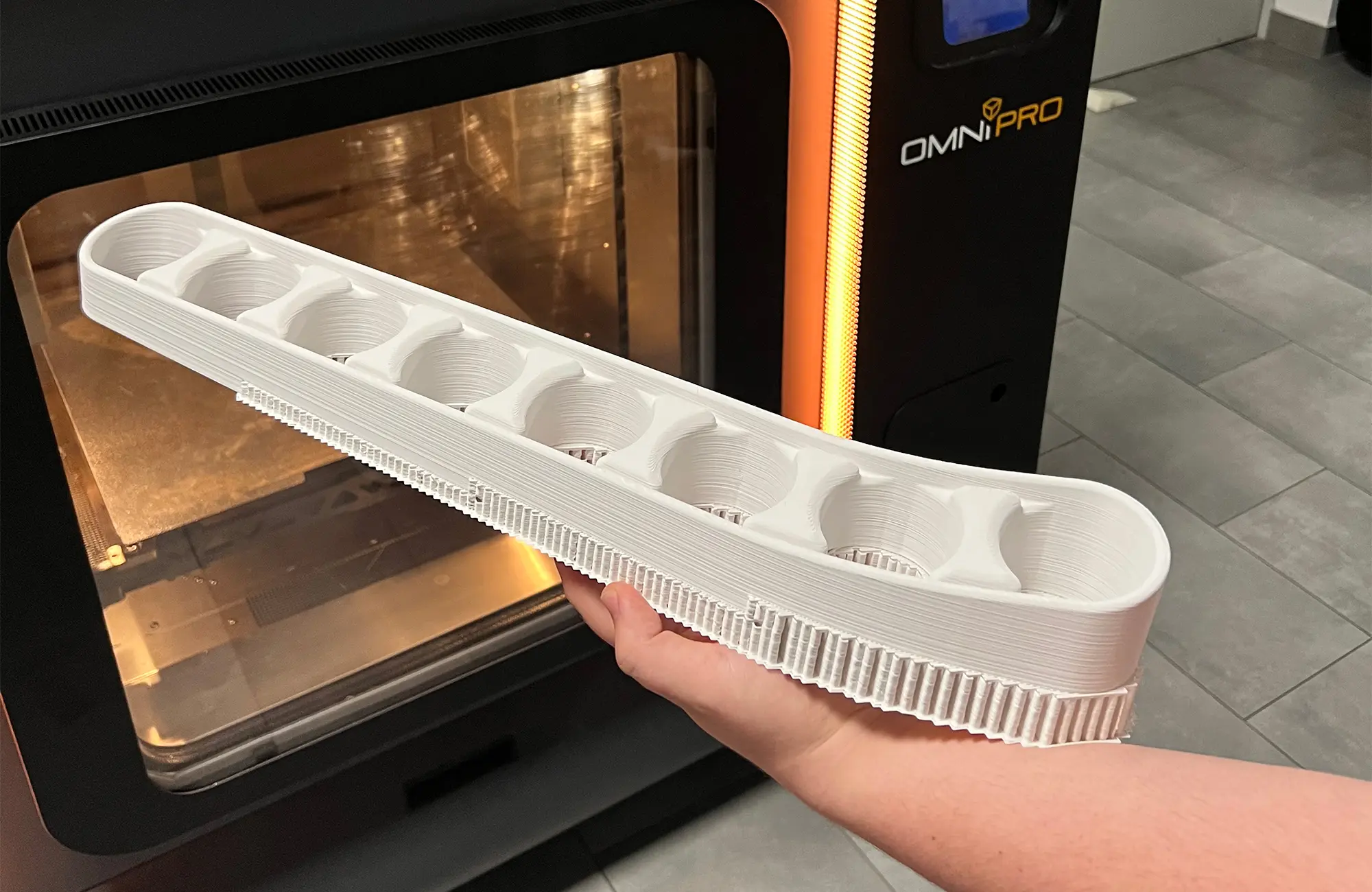
Industrial 3D printing services help manufacturers produce functional components, solve legacy spare-part shortages and create lighter, more efficient assemblies. For railway operators, defense contractors and industrial OEMs, additive manufacturing opens a practical route from a digital design to a production-ready part.
Omni3D combines industrial printing expertise with engineering support to help companies move projects forward—from a custom tool or replacement component to a low-volume production run.
Why choose Omni3D for industrial 3D printing services?
Moving from machining or injection moulding to additive manufacturing is easier with a partner who understands the complete application. Omni3D works with engineering, R&D and procurement teams to connect design decisions with manufacturing needs.
Engineering support from design to production
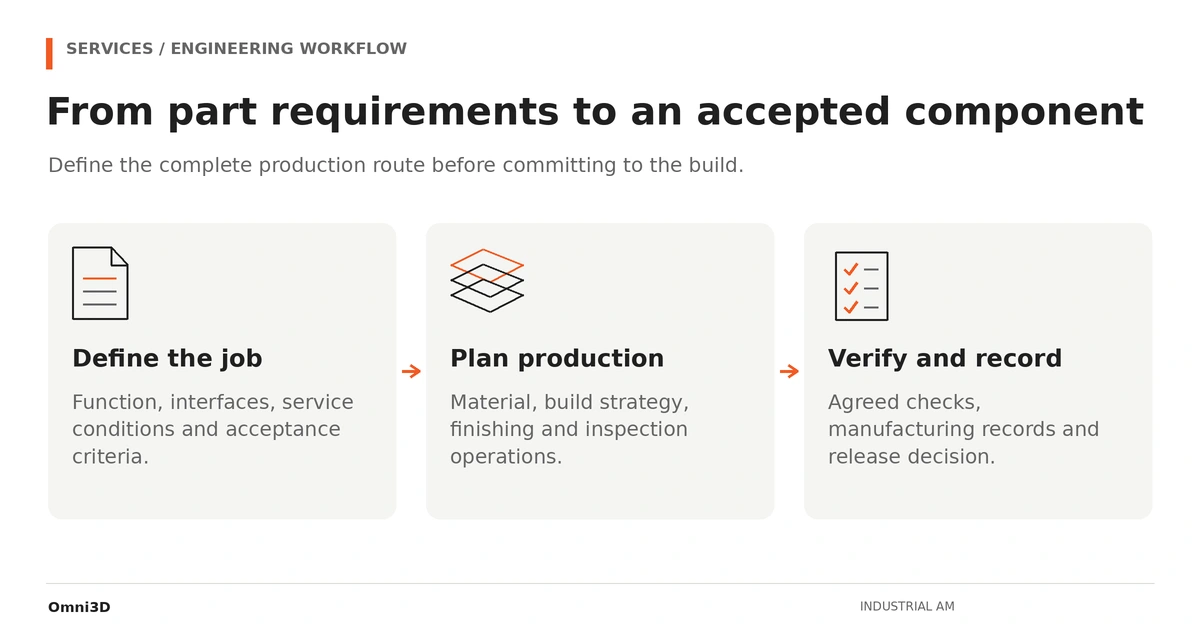
Our team supports projects through Design for Additive Manufacturing (DfAM), material selection and post-processing. This can include adapting a design for printing, reducing unnecessary weight or combining several components into a simpler assembly.
The aim is to make the part work better for its intended use while keeping production practical. A lighter fixture, a customized enclosure or an integrated mounting solution can each provide value in a different way.
Repeatable quality and traceability
Every production run is governed by strict quality management protocols, complete with batch traceability, dimensional inspection, and documented material certifications.
This helps manufacturers maintain consistency across repeat orders and gives procurement teams the documentation they need to integrate additive manufacturing into their supply chain.
Flexible production without dedicated moulds
Additive manufacturing makes it possible to produce complex geometries and low-to-medium volume runs without investing in a dedicated injection mould. It also makes design updates easier to introduce when a component or production requirement changes.
Omni3D’s on-demand manufacturing services help teams evaluate the right approach for custom parts, tooling and recurring production needs.
Railway-certified 3D printing: built for safety and longevity
Long-serving rolling stock can become difficult to maintain when original tooling is no longer available or replacement parts are hard to source. Omni3D’s railway-certified 3D printing services enable operators and Tier-1 suppliers to manufacture compliant, track-ready components on demand.
Full compliance with EN 45545-2 standards
In the rail industry, using a flame-retardant filament is not enough; the final printed component must meet rigorous fire, smoke, and toxicity (FST) standards.
Certified materials and processes: We utilize validated high-performance polymers (such as ULTEM™ 9085, PEKK, and specialized flame-retardant polyamides) processed under strictly controlled parameters to satisfy EN 45545-2 hazard levels (HL1, HL2, and HL3).
Applications include air ducts, HVAC louvers, electrical enclosures, cable brackets, seating components and custom interior fittings. This flexibility helps railway teams address both replacement needs and new component designs.
Digital warehousing for legacy fleets
Digital part records allow selected spare parts to be produced when needed, helping operators manage obsolescence and reduce dependence on physical stock. Once a component has an established production route, its digital definition can support future orders.
For more on materials and production, explore Omni3D’s railway additive manufacturing guidance.
Defense 3D printing services: rugged, traceable and mission-ready
Defense contractors and military supply chains need durable components, responsive manufacturing and dependable documentation. Omni3D provides defense 3D printing services designed to support deployment and strengthen supply-chain resilience.
Strict regulatory and quality compliance: Our workflows align with rigorous defense and aerospace standards (such as AS9100, ISO 9001, and relevant military specifications/MIL-SPEC requirements), ensuring full material traceability from raw powder or filament to finished part.
Omni3D also holds AQAP 2110:2016 certification for its 3D-printer, additive-manufacturing-service and drone operations, and is NCAGE-listed under code 9BT1H.
Applications include UAV payload mounts, ruggedized sensor housings, custom field-maintenance tooling and low-volume hardware. Design flexibility allows teams to adapt components to specific equipment and explore opportunities to simplify assemblies or reduce weight.
Omni3D’s guide to secure additive manufacturing for defense explores the role of controlled production data and manufacturing infrastructure in these workflows.
Industrial OEMs: practical solutions for the factory floor
For industrial manufacturers, additive manufacturing can address everyday production challenges: a fixture that is difficult to source, a customized assembly aid or a spare part that is holding up maintenance.
Printed tooling can be shaped around a specific workstation or component. Functional parts can incorporate features that would otherwise require multiple manufacturing or assembly steps. Small production runs can also be developed without committing to conventional tooling at the outset.
Omni3D’s maintenance applications show how industrial printing can support equipment upkeep and replacement-part needs.
| Sector | Typical challenge | Additive manufacturing opportunity |
|---|---|---|
| Railway and rolling stock | Obsolete spare parts and fire-safety requirements | On-demand replacement parts and certified end-use applications |
| Defense and aerospace | Supply-chain bottlenecks and weight targets | Lightweight components, equipment interfaces and maintenance tooling |
| Industrial OEMs | Custom tooling costs and low-volume demand | Jigs, fixtures, functional parts and flexible production runs |
Bring your next project to Omni3D
Whether you are developing a railway component, adapting defense equipment or improving a factory-floor tool, a clear project brief helps turn an idea into a manufacturing plan.
Share your CAD model or technical drawing, the part’s intended use, your preferred material and the quantity required. Include the delivery needs and any essential quality requirements so the team can focus on the right solution.
Discuss your application with Omni3D and take the next step toward industrial additive production.




