
The Engineer’s Prerogative: Precision Over Hype
For the Omni3D Engineering Division, industrial Material Extrusion (FFF) is not a magic wand, but a sophisticated thermal process governed by the laws of thermodynamics and polymer science.
The most successful manufacturing floors are not those that replace traditional methods entirely, but those that understand the Idoneity Gap: the precise moment where the benefits of geometric freedom and rapid lead times are outweighed by the requirements for absolute isotropy or high-volume economic scaling. This technical guide moves beyond the marketing gloss to provide a data-driven framework for choosing between FDM, CNC machining, and injection molding.
1. The “Idoneity Gap” in Advanced Manufacturing
What are the main limitations of industrial 3D printing for series production?
The primary limitations of industrial FDM (Material Extrusion) are
- mechanical anisotropy (inter-layer adhesion weakness),
- surface roughness (Ra) exceeding sub-micron tolerances, and a
- Total Cost of Ownership (TCO) crossover point where injection molding or CNC machining becomes more cost-effective for high-volume batches (typically >500 units, depending on geometry).
The “Idoneity Gap” is the space where additive manufacturing (AM) technically functions but is economically or mechanically suboptimal. For the Omni3D engineering community, understanding and defining it is critical for maintaining production integrity.
2. Technical Comparison: FDM vs. CNC vs. Injection Molding
In industrial applications, the choice of technology is dictated by the required Isotropic properties and the Surface Finish (Ra).
| Feature | Industrial FDM (Omni PRO) | CNC Machining | Injection Molding |
| Material Properties | Orthotropic (Z-axis variance) | Isotropic | Isotropic |
| Surface Roughness | 10–50 µm (Raw) | < 0.8 µm | < 0.1 µm |
| Lead Time | 24–72 Hours | 2–4 Weeks | 8–12 Weeks |
| Ideal Volume | 1 – 100 parts | 10 – 500 parts | 1,000+ parts |
| Geometry | Infinite Complexity | Tool-path Limited | Mold-path Limited |

When should you switch from 3D printing to CNC Machining?
Switch to CNC machining when the application requires absolute vacuum sealing, sub-0.05mm dimensional tolerances, or when the part must withstand high-shear stress in a direction perpendicular to the layer lines (Z-axis). While Omni3D systems utilize Active Heated Chambers up to 220C to mitigate Z-axis weakness, subtractive manufacturing remains the gold standard for isotropic homogeneity.
3. High-Performance Polymers: PEEK, PEKK, and ULTEM™
In Aerospace and Defense, the material choice is as important as the process.
Is FDM suitable for high-load structural aerospace parts?
Industrial FDM is suitable for structural parts when using high-performance polymers like ULTEM™ 9085 or PEEK, provided the design accounts for ASTM D638 tensile strength variations. While PEEK offers excellent chemical resistance and a high Strength-to-Weight ratio, engineers must validate the Crystallinity of the printed part to ensure it meets aerospace standards.
- Omni3D Insight: Our Omni PRO HT maintains a 220°C chamber temperature to promote secondary crystallization, significantly narrowing the “Anisotropy Gap“ compared to desktop-grade printers.
4. The TCO Crossover: Assessing Economic Viability
The decision to use Additive Manufacturing is often an economic one. We define the TCO Crossover Point as the specific volume where the cost-per-part of Injection Molding (including tooling amortization) drops below the static cost-per-part of FDM.
How do you calculate 3D Printing ROI?
Calculate ROI by factoring in the Cost of Delay. If a CNC part takes 4 weeks to arrive, the “Hidden Cost“ is 4 weeks of stalled R&D. Industrial FDM provides “Zero-Cost Complexity”, meaning a complex internal cooling channel costs the same to print as a solid block, this is where FDM wins, even at slightly higher per-unit costs.
How do you calculate the Total Cost of Ownership (TCO)?
The Total Cost of Ownership (TCO) for additive manufacturing is linear, whereas injection molding is logarithmic.
Linear Scaling: FDM print time scales linearly; 100 parts take 100 times longer than one part. There are no efficiencies gained through high-volume production, unlike injection molding.
The Data: For a 150g industrial housing, the Omni3D ROI is highest between 1 and 500 units.
High Cost-Per-Part: For thousands of units, injection molding reduces cost-per-part significantly through the amortization of tooling, whereas FDM remains expensive per unit.
The Pivot: Once production reaches the 1,000+ unit threshold, the amortized cost of a $50,000 steel mold becomes more efficient than the machine-hour rate of even the fastest BigRep or Stratasys systems.
Strategic Value: Use AM for Bridge Tooling to achieve “First-to-Market” status while traditional tooling is being fabricated (typically a 12-week lead time).
5. Hybrid Manufacturing: The Best of Both Worlds
Can 3D printing be used to improve traditional molding?
Yes, through 3D Printed Tooling or “Rapid Molds”. By printing mold inserts in high-temp polymers or metal, manufacturers can achieve Bridge Production fulfilling the first 50–100 units while a traditional steel tool is still being machined, reducing time-to-market by up to 80%.
For teams needing the precision of molding with the speed of AM, we recommend 3D Printed Tooling.
- Rapid Molds: Use high-temp resins or filaments to print injection mold inserts.
- Bridge Production: Use Omni3D to fulfill the first 100 units while the steel tool is being machined.
Final Engineering Verdict
Industrial Material Extrusion is not a replacement for traditional manufacturing, but a strategic supplement. 3D printing and injection molding are not rivals; they are stages of a product’s lifecycle. If you need speed, flexibility, or complex geometries for the railway or aerospace sectors, Industrial FFF is unmatched. For mass-market consistency, traditional methods remain king.
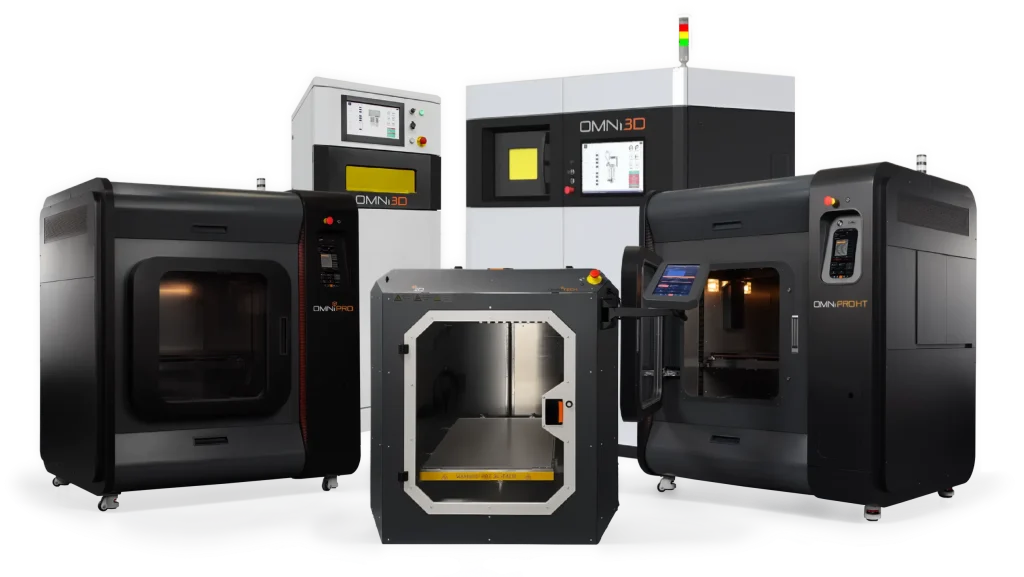
Use Omni3D Industrial FDM when:
- Lead time is the primary bottleneck for critical spares.
- Weight reduction via internal lattices is required (Aerospace/UAV).
- Complex geometries make CNC tool-paths physically impossible.
- Material Certification (EN 45545 / UL94-V0) is mandatory for large-format parts 3D printed, glued, and painted.
Unsure which path fits your current BOM? Contact the Omni3D Engineering Division at sales@omni3d.com for a technical assessment of your CAD files..







