
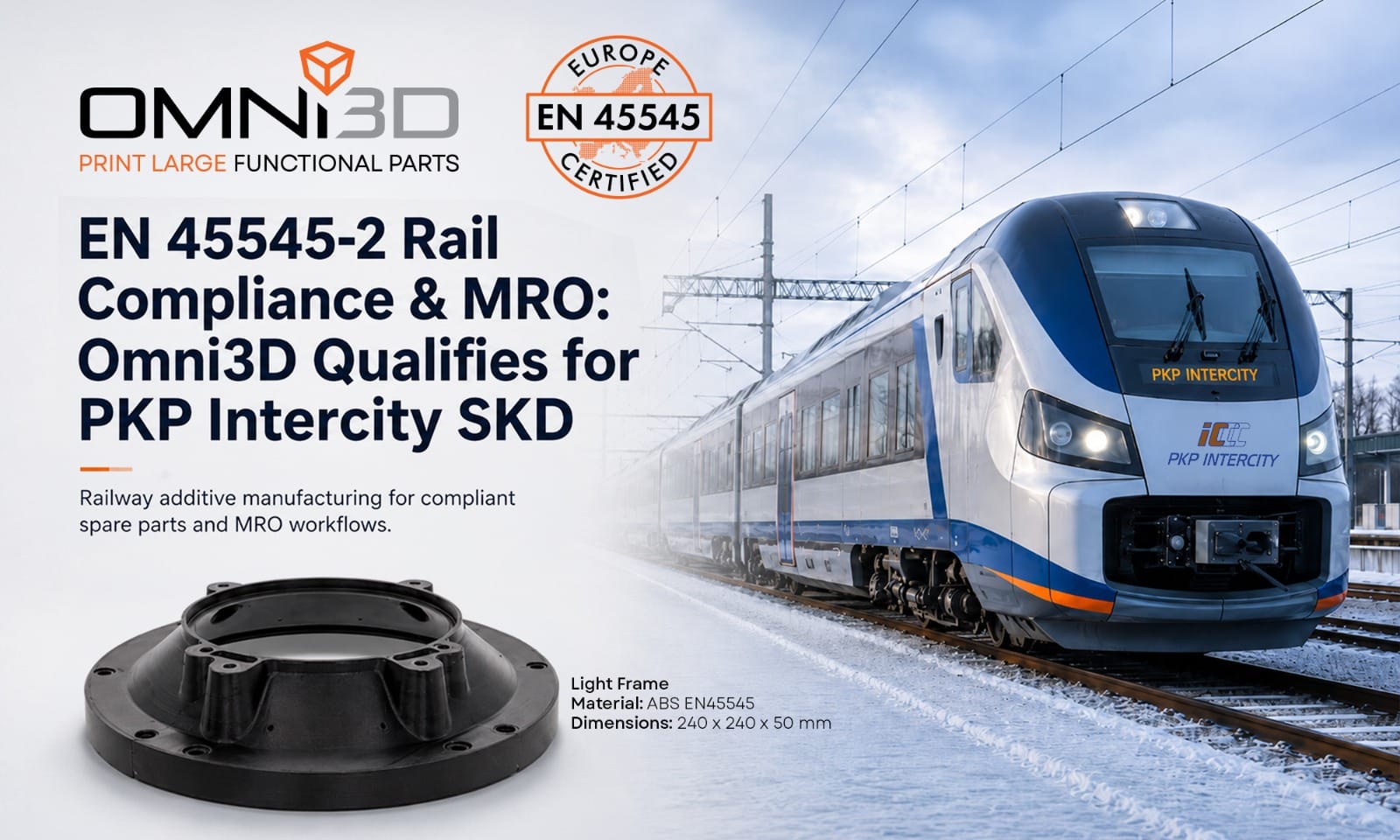
EN 45545-2 HL3 compliance is one of the most demanding requirements for railway additive manufacturing. Achieving it requires a validated combination of certified materials, industrial printing parameters, thermal control, component geometry, adhesives, paints, and post-processing—not simply the use of a flame-retardant filament.
The European rail transport sector represents a €140 billion industry. Yet, maintenance operations remain severely constrained by supply chain bottlenecks, component obsolescence, and massive physical inventory overhead. European railways operate approximately 65,000 locomotives and 65,000 passenger wagons. Industry analyses, including data from operator SNCF, indicate that up to 10.3% of legacy spare parts across portfolios exceeding 30,000 SKUs can be manufactured via material extrusion 3D printing, cutting maintenance lead times by up to 85%.
However, integrating 3D printing into passenger rolling stock requires meeting Europe’s stringent fire safety standard: EN 45545-2. At InnoTrans 2026, Omni3D presents an end-to-end, certified additive manufacturing ecosystem designed to move 3D printing out of the lab and directly onto operational track systems.
Deconstructing EN 45545-2: Hazard Levels (HL1 to HL3) and Testing Rigor
Fire safety compliance under EN 45545-2 is governed by a matrix combining Operation Categories (OC 1 to OC 4), defined by infrastructure constraints such as tunnel length and lateral evacuation accessibility, and Design Categories (e.g., standard, automatic, double-decker, or sleeping cars).
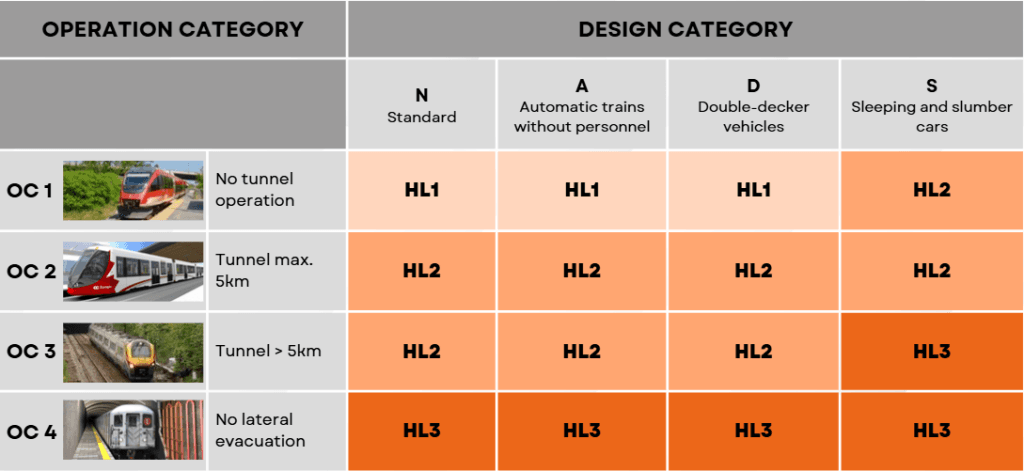
While Hazard Level 2 (HL2) covers approximately 80% of the current European railway market, high-risk operating environments, such as sleeper cars (Design Category S) operating in tunnels exceeding 5 km (OC 3) or systems without lateral evacuation options (OC 4), mandate Hazard Level 3 (HL3) compliance.
To achieve HL3, materials must pass strict standardized laboratory testing:
- ISO 5658-2: Lateral flame spread on vertical surface configurations.
- ISO 5660-1: Heat release rate (cone calorimeter analysis).
- EN 17084: Smoke optical density and toxic gas emissions testing.
Thermal Control and the CTE Mismatch Challenge
Printing high-performance polymers for railway applications involves managing internal thermal gradient stress. High-temperature, semi-crystalline, and amorphous thermoplastics like PEI (ULTEM™) 9085 and high-grade PC-FR feature significant Coefficients of Thermal Expansion (CTE).
When processing large-scale functional parts, such as cab interior covers, lighting housings, or passenger tables, uneven thermal cooling causes internal stresses that lift part extremities from the build platform.
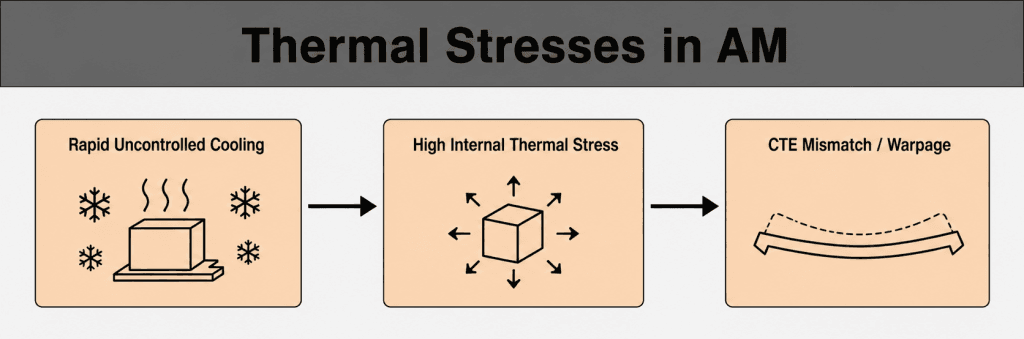
To prevent dimensional deviation and layer delamination, industrial systems must provide precise thermal management:
- Actively Heated Build Chambers: The Omni PRO HT maintains active chamber temperatures up to 220°C. This keeps the polymer above its glass transition temperature (Tg) during build cycles, relaxing internal stresses and ensuring isotropic interlayer bonding.
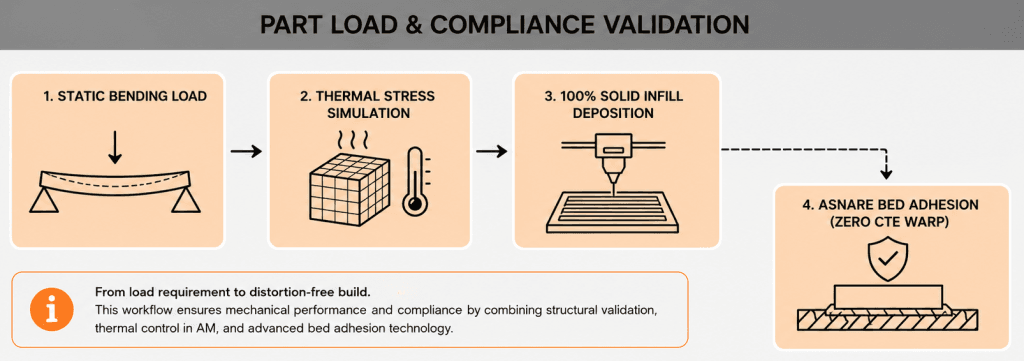
- Validated Bed Adhesion: Using chemical bonding agents like ASNARE, build platforms maintain high shear adhesion during deposition, ensuring first-layer stability without part distortion.
The Complete Ecosystem: Print, Glue, and Paint
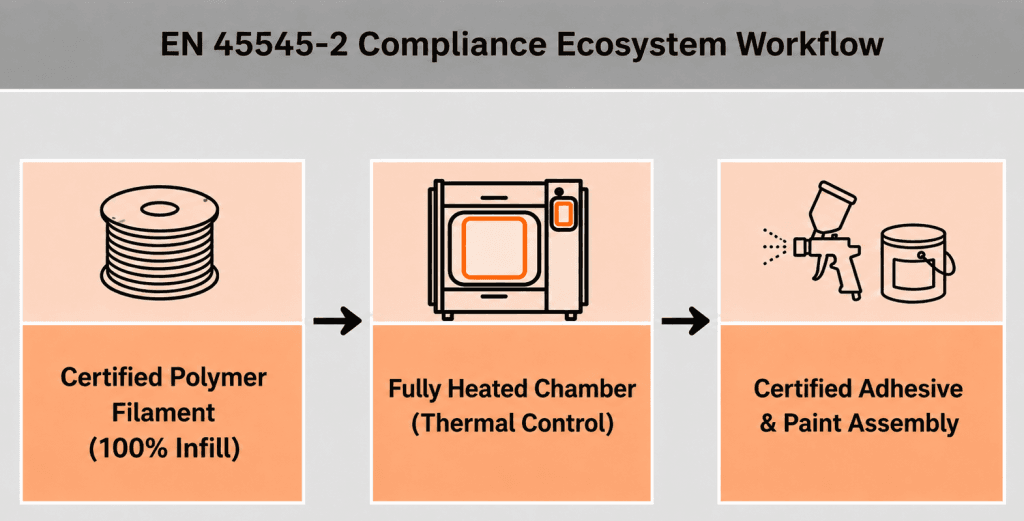
A key barrier to deploying 3D printed components in rail vehicles has been assembly post-processing. A compliant raw filament loses its certification if combined with non-compliant structural adhesives or industrial paints.
Omni3D Certified End-to-End System
| 1. Certified Material | ABS EN 45545 / Airtech PC-FR / PEI 9085 |
| 2. Controlled Process | Omni PRO HT / Omni PRO — 100% infill profiles |
| 3. Certified Joining | EN 45545-compliant structural adhesive |
| 4. Certified Surface | EN 45545-compliant industrial paint/varnish |
Omni3D’s comprehensive EN 45545-2 certification covers the entire manufacturing process chain:
- Certified Materials: ABS EN 45545 (HL2/HL3 R22/23), Airtech PC-FR (HL3 R1, R2, R6, R7, R17), and PEI 9085 (HL3).
- Certified Adhesives: Allows multi-section large-format parts to be bonded without compromising fire, smoke, or toxicity safety ratings.
- Certified Paints: Enables custom color matching and surface finishing while maintaining full regulatory compliance.
Industrial Reality: Engineering Trade-Offs
Industrial additive manufacturing requires balancing engineering trade-offs:
- Surface Roughness vs. Production Speed: Material extrusion leaves visible layer lines (stair-stepping). While post-processing (sanding, painting) achieves OEM surface aesthetics, non-aesthetic functional components (internal ducts, mounting brackets) should remain in their as-printed state to minimize lead times.
- Infill Density Requirements: The certified Omni3D process uses validated 100% infill profiles, as internal voids may alter flame propagation and heat-release performance compared with the tested component configuration.
- Enclosure & Build Volume Constraints: Machine envelope limits (530×530×515 mm) mean oversized structures (such as full tramcar front panels) must be segmented, printed in sections, and joined using certified structural adhesives.
Visit Omni3D at InnoTrans 2026 to inspect certified functional components, review complete fire safety test documentation, and evaluate our high-temperature industrial hardware fleet.
Maintenance Operations: Replacing CNC Passenger Car Folding Tables via On-Demand FFF Printing
Executive Summary
A European passenger rail operator faced long procurement lead times and high minimum order quantity (MOQ) requirements for replacement seat folding tables across aging regional fleets. Traditional CNC aluminum or injection-molded replacements required extended supply lead times, causing vehicle downtime. Utilizing the Omni PROindustrial printer and Airtech PC-FR polymer, Omni3D produced EN 45545-2 R1 certified functional replacement assemblies on-demand.
| Comparison | CNC Machining | Omni3D AM |
|---|---|---|
| Lead Time | 8 weeks | 1 week |
| Batch Cost | €900 | €300 |
| Minimum Order Quantity | 9 units | 9 units |
Key Operational & Financial Metrics
| Metric Parameter | Legacy Manufacturing (CNC) | Omni3D Additive Solution | Absolute Delta / Savings |
| Material Formulation | Machined Aluminum / Non-FR Polymer | Airtech PC-FR (Flame Retardant) | EN 45545-2 R1 Compliant |
| Production Lead Time | 8 Weeks | 1 Week | 7 Weeks (87.5% Reduction) |
| Batch Production Cost (MOQ: 9 Units) | €900 | €300 | €600 (66.6% Cost Reduction) |
| Fire Safety Certification | Component-Level Testing Required | Certified EN 45545-2 HL3 (R1) | Full Regulatory Compliance |
Engineering Execution & Technical Parameters
Folding Table Technical Details
| Component Category | Interior Passenger Furniture — Requirement Class R1 |
| Polymer Selection | Airtech PC-FR — Polycarbonate Flame-Retardant |
| Printer System | Omni PRO Industrial Dual-Extrusion System |
| Build Parameters | Chamber temperature: 85°C · Nozzle temperature: 290°C |
| Infill Configuration | 100% solid infill — EN 45545 testing standard |
| Platform Adhesion | ASNARE Chemical Bonding Layer |
- Material Selection: Airtech PC-FR was selected for its mechanical durability (XZ tensile yield strength improvement) and compliance with EN 45545-2 Requirement Class R1 (interior wall, ceiling, and furniture surfaces).
- Thermal & Mechanical Optimization: The table was sliced using a 100% solid infill profile to maintain fire-retardant compliance. The build chamber was maintained at 85∘C to manage internal thermal stress and prevent warping across the part’s footprint.
- Bed Adhesion Control: ASNARE adhesive was applied to the glass platform prior to heating, securing the component footprint and allowing easy removal after thermal cooling.
Operational Results
- Elimination of Minimum Order Quantities: The operator produces components in exact required quantities (1 to 9 units) without paying low-volume machining penalties.
- Direct Downtime Reduction: Replacement cycles were reduced from two months to single-week turnarounds, returning passenger cars to operational service faster.
- Mass Reduction: The lightweight PC-FR table reduces interior assembly weight compared to legacy metal structures, contributing to overall energy efficiency.
Meet Omni3D at InnoTrans 2026
Omni3D will be exhibiting at InnoTrans 2026, taking place from 22–25 September 2026 in Berlin, Germany.
Visit us in Hall 1.1, Stand 120 to discover how certified additive manufacturing can support railway manufacturers with compliant interior components, replacement parts, tooling, and low-volume production.
Our team will be available to discuss your railway applications, material requirements, and the importance of obtaining EN 45545-2 certification for the final printed component—not only for the raw filament.
Meet Omni3D at InnoTrans 2026
22–25 September 2026
Berlin, Germany
Hall 1.1, Stand 120







