
Industrial 3D printing at MSV 2026 is an opportunity to connect equipment choices with practical manufacturing needs: a fixture that takes too long to source, a tool that needs frequent revision or a short production run that is difficult to schedule.
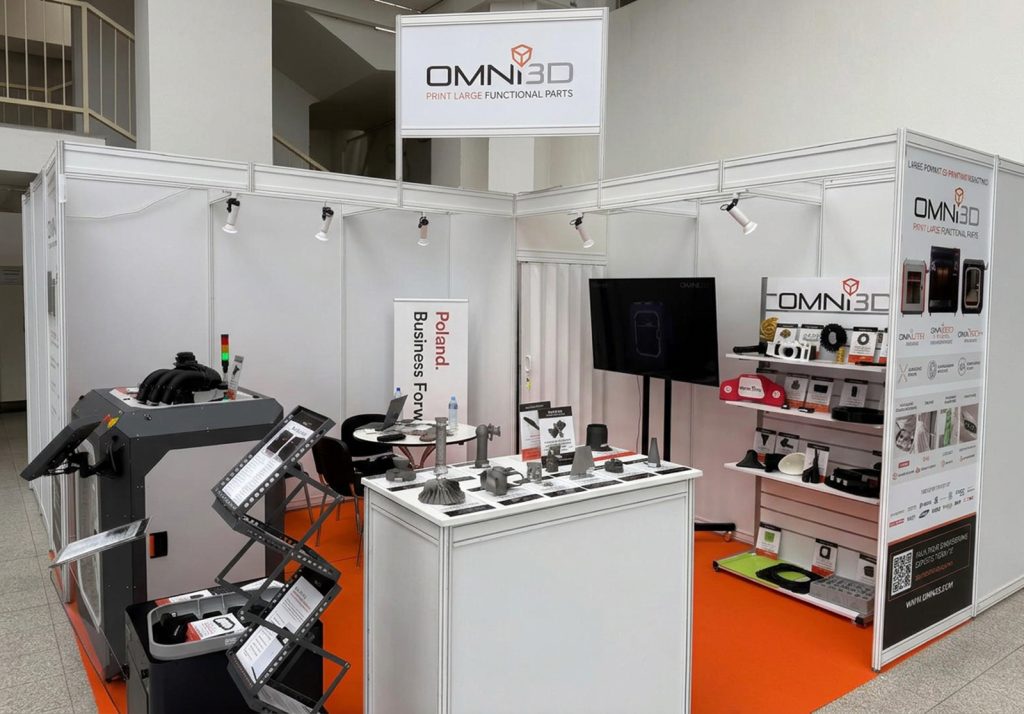
Omni3D is exhibiting at the MSV International Engineering Fair in Brno, Czech Republic, from 6–9 October 2026, Hall A1, Booth 011. The focus is on industrial polymer and metal additive manufacturing, with tooling and production applications at the centre of the discussion.
Explore industrial 3D printing at MSV 2026 through real requirements
A useful equipment conversation begins with the part. What does it locate, carry or protect? Which surfaces determine fit? What temperatures, loads and chemicals will it encounter? How will the factory accept it for use?
The official MSV exhibitor profile introduces Omni3D’s polymer and metal manufacturing portfolio. The practical next step is to match that portfolio to a defined production requirement.
For an assembly fixture, that may mean balancing stiffness, handling weight and replaceable contact surfaces. For a metal component, it may mean evaluating geometric freedom alongside finishing and inspection. For a large polymer tool, the thermal process can be as important as the available build space.
Polymer tooling: control the whole thermal process
Material extrusion builds a component through successive deposited paths. As the material heats and cools, the thermal history influences the result. Large footprints and changing section thicknesses can make dimensional control more demanding.
NIST research on FFF polycarbonate links environmental temperature and moisture with geometry and mechanical behaviour. For production planning, that makes material conditioning and thermal control relevant parts of the process definition.
Omni3D’s Omni PRO HT offers an actively heated chamber up to 220°C. That capability provides a processing option for demanding polymer applications; the correct operating profile must still be selected for the material grade and geometry.
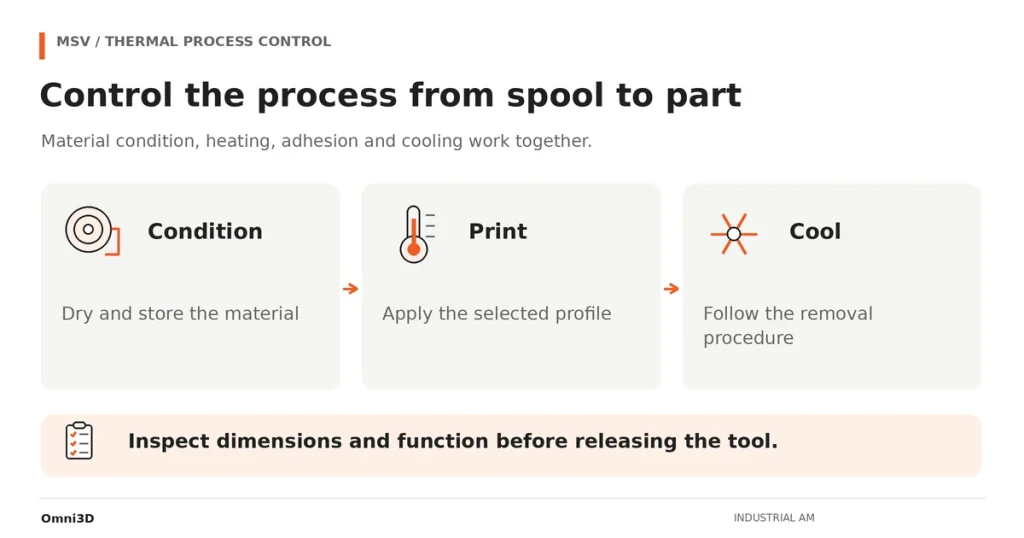
Treat the workflow as a connected sequence: condition the material, prepare the build surface, apply the selected thermal profile, control cooling, and inspect the finished part. A single maximum temperature cannot describe all of those steps.
First-layer adhesion and finishing belong in the plan
First-layer adhesion helps the part remain attached during the build. Build-surface preparation, material compatibility and removal conditions need to be considered together. Omni3D discusses ASNARE within its guidance on adhesion for high-temperature 3D printing.
Define the adhesion procedure for the actual platform and material combination. Good adhesion supports the build, but it does not eliminate every cause of internal stress or distortion.
Plan finishing before printing. Locating holes, threaded connections and wear surfaces may need inserts or secondary machining. Include those operations when comparing lead time, cost and the effort needed to reproduce the tool.
Metal LPBF: a complementary production route
Where the application requires metal, the Omni M150 and Omni M280 systems provide LPBF options to evaluate. Match the machine configuration and process to the alloy and component requirements.
Include powder handling, build removal, any required treatment, machining and inspection in the review. The decision should compare complete production routes at the required acceptance level.
Polymer and metal AM can address different parts of the same manufacturing programme. The useful question is which process serves each component, rather than whether one technology can replace every conventional operation.
Bring the right information to the discussion
Bring a representative drawing or CAD model, the current manufacturing route, annual demand and the critical acceptance requirements. If available, include actual lead times, finishing effort and the cost of the accepted tool.
Those inputs make it possible to discuss a concrete next step: a sample, a material review, a service project or an equipment evaluation. Omni3D’s industrial 3D printing services can provide an entry point where the application needs to be tested before an investment decision.
Meet Omni3D at MSV 2026 in Hall A1, Booth 011. Share the manufacturing problem you want to solve and discuss the polymer or metal workflow that could address it.







