
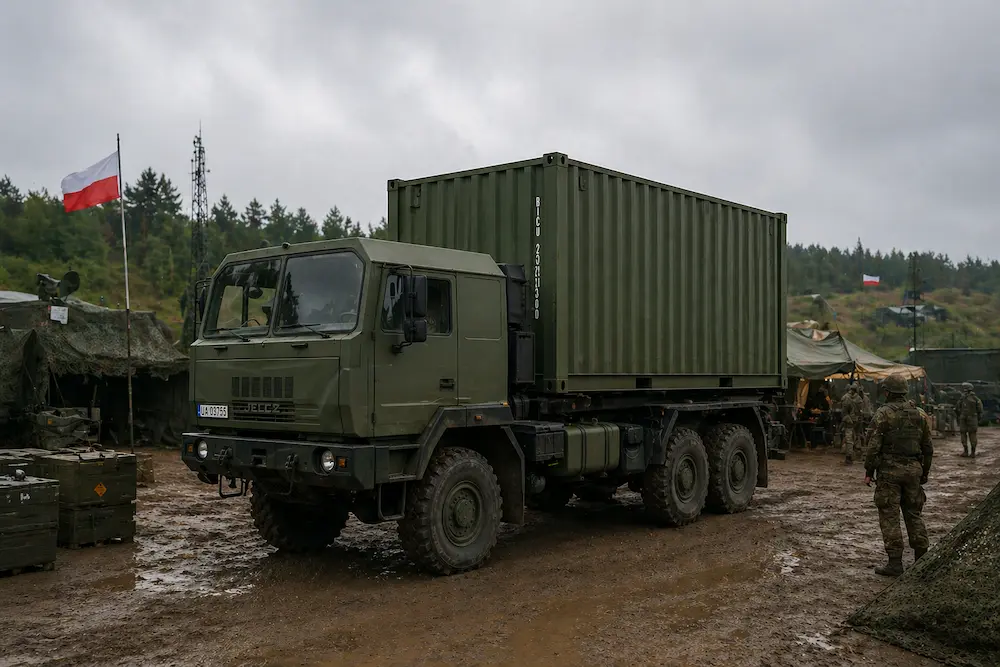
Forward-deployed additive manufacturing moves qualified production closer to the point of need, reducing dependence on slow and fragile spare-parts logistics.
Under operational stress, the first system to fail is often not the equipment itself, but the supply chain behind it. Traditional procurement is constrained by minimum order quantities, long lead times, storage requirements, and multi-supplier dependencies, especially during geopolitical disruptions.
By combining secure digital inventory with validated local production workflows, defense organizations can manufacture critical parts where they are needed instead of waiting for them to arrive from a central depot.
This approach aligns with the U.S. Department of Defense Additive Manufacturing Strategy, which identifies supply-chain agility, materiel readiness, secure workflows, and point-of-need production as central benefits of AM adoption.
The Core Shift
From physical inventory → to digital inventory From shipping spares → to shipping validated files From waiting on suppliers → to local production with qualified materials
The result: a self-sufficient manufacturing capability at the point of need, not weeks away in a central depot.
This is the central value of forward-deployed additive manufacturing: qualified production becomes available at the point of need instead of weeks away in a central depot.
What Actually Changes: Traditional Spares vs. In-Situ AM
| Traditional Spares | In-Situ AM | |
|---|---|---|
| Availability | Depends on suppliers and transport chains. | Depends on local capacity and validated files on hand. |
| Inventory | Physical stock with significant storage footprint. | “Digital stock” plus materials, no warehouse required. |
| Speed | Lead times plus logistics friction. | On-demand printing with local post-processing. |
| Resilience | Vulnerable to external disruptions. | Greater autonomy at remote and forward sites. |
| Governance | Supplier QA and procurement controls. | Digital security, traceability, and access controls. |
Where In-Situ AM Delivers the Highest Value
Not everything should be printed in the field.
The sweet spot is high-impact items that are hard to source quickly.
| Application | Why it works for In-Situ AM |
|---|---|
| Replacement parts for obsolete equipment | Parts that no longer exist on the shelf. Engineering polymers and composites bridge the gap. |
| Tools, jigs, and fixtures | Fast iteration, low volume, immediate operational utility. Reinforced polymers handle the job. |
| UAV components (select parts) | Rapid iteration and weight optimization. Lightweight polymers and composites. |
| Training props and decoys | Realism plus fast turnaround. Lightweight, deployable, and cost-effective. |
| Equipment brackets and covers | Often non-safety-critical but mission-critical. Tough polymers, ESD variants where needed. |
Materials: The Real Capability Multiplier
Forward production succeeds or fails on materials. Mission-specific performance, not generic plastic parts, is what matters.
Omni3D’s defense-grade material range includes:
- ABS ESD: for electrostatic-sensitive environments
- TPU: flexible applications requiring impact absorption
- ASA: UV and weather resistance for outdoor deployment
- PEKK / PEEK: super-polymers with metal-like strength and durability, validated for high-demand defense applications, including structural brackets
The mindset is simple: match the material to the job, not the other way around.
Security, Traceability, and Governance
Defense organizations don’t just need a printer, they need a controlled manufacturing system. Omni3D’s software ecosystem is built for exactly that:
- AES-256 encryption for all design files and .gcode
- Role-based access control (RBAC) by user and site
- Full audit logs: user, date, file downloaded, and public IP recorded
- Centralized control with closed-loop traceability across distributed sites
This matters because in-situ AM replaces supplier governance with digital governance: who can access which designs, how uncontrolled part variants are prevented, and how traceability is proven if an incident occurs.
A successful forward-deployed additive manufacturing program requires more than installing printers at remote sites. It depends on validated parts, controlled processes, trained personnel, and secure file distribution.
A Deployment Blueprint: How Successful Programs Are Structured
Choose a “Top 50” starter set. Identify parts and tools that drive the most downtime and are feasible to validate for field production.
Create validated production packages. Lock in design intent, material spec, print parameters, post-processing steps, and inspection criteria.
Build a digital warehouse. Store validated files and distribute them securely to forward sites via Omni3D’s encrypted platform.
Train personnel and standardize workflows. Treat the operator and the process as part of the system, not an afterthought.
Scale to printer fleets where it makes sense. Not every site needs a fleet. Some need one robust cell; others need throughput. Size to the mission.
TFU20: Omni3D’s Field-Ready Manufacturing Node
Once the logic above is accepted, the practical question becomes: what does a forward manufacturing node actually look like in the field?
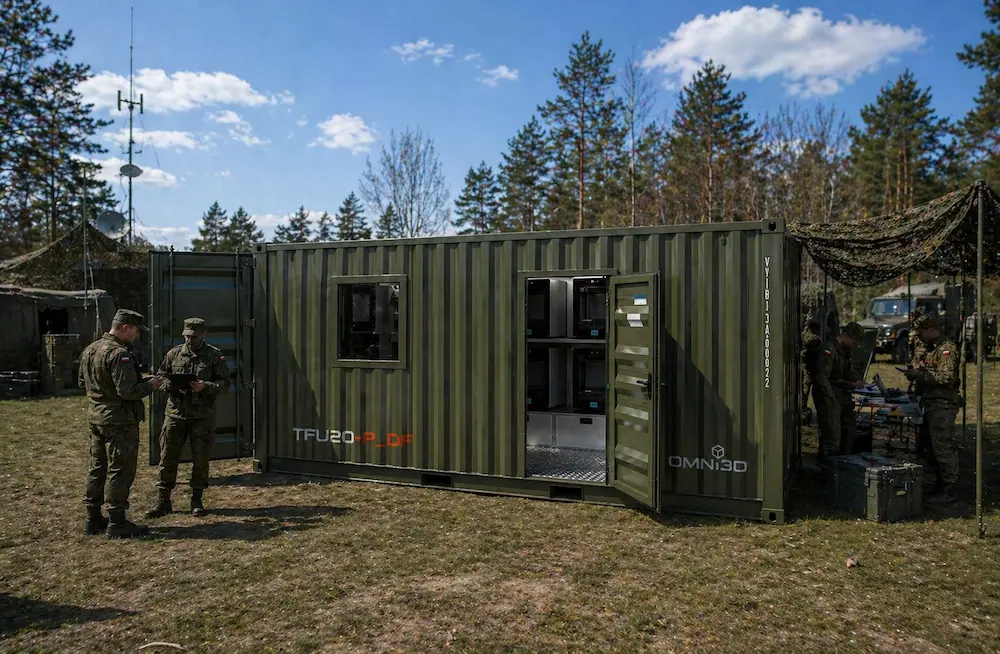
Omni3D’s TFU20 is a deployable, self-contained additive manufacturing lab designed to support on-site production and reduce reliance on traditional supply chains. It ships as a complete, operational unit, power, climate control, ventilation, and printing infrastructure included, so it can be set up and running at a forward site without external dependencies.
The TFU20 is configurable for different mission profiles: from high-performance polymer spare parts production to dedicated UAV component manufacturing. The operational loop it enables is straightforward, urgent need arises, the validated file is transmitted securely from HQ, the part is printed and installed on-site, readiness restored.
The container is the hardware wrapper. The digital workflow is what makes it a system. TFU20 turns forward-deployed additive manufacturing into a practical, field-ready capability.
Want to know more about TFU20 configurations and deployment options? Contact our team.
Frequently Asked Questions
What is forward-deployed additive manufacturing?
It’s the practice of producing qualified parts and tools near or at the operational site, using secure digital inventory and validated processes, instead of relying solely on centralized depots and long supply chains.
Is in-situ AM only for spare parts?
No. Use cases include tools and jigs, components for obsolete equipment, training props, decoys, and selected UAV components. Omni3D’s material range significantly expands the viable application scope.
What makes a defense AM workflow credible?
Repeatability plus governance: validated production packages, controlled access, AES-256 encryption, traceable logs, and standardized inspection steps, all integrated into Omni3D’s software ecosystem.
What makes Omni3D different from other AM providers?
The combination of industrial multi-material hardware, defense-grade software security, and genuine forward-deployment capability through the TFU20 positions Omni3D as one of the few vendors with a real end-to-end solution for demanding operational environments.







