
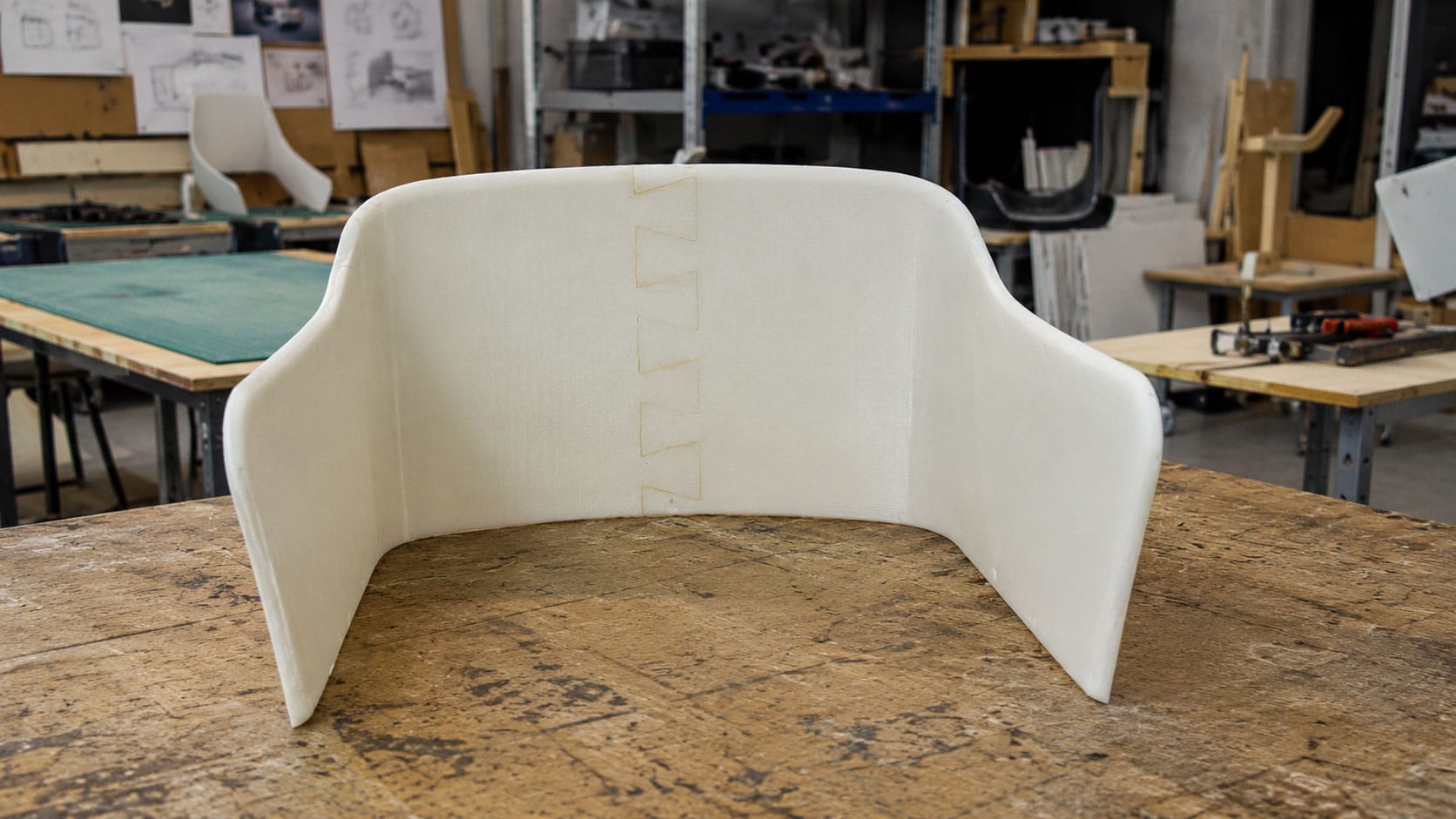
Large-format ABS 3D printing provides furniture manufacturers with a lower-risk method for validating structural components before investing in conventional production tooling. Working with FUSS sp. z o.o. (Furnsolutions), Omni3D manufactured a full-scale component for the Silence Chair measuring approximately 587 × 550 × 336 mm. This case study examines the slicing strategy, active thermal management, bed adhesion, post-processing, production time, and unit economics behind the 69-hour industrial build.
Large-Format ABS 3D Printing for Furniture Component
When engineering large-format commercial furniture components, physical load verification and functional pre-series manufacturing present significant capital and time risks. Traditional tooling, such as aluminum or steel injection molds, requires weeks of lead time and five-figure capital expenditures before a single physical unit can be evaluated for structural compliance, ergonomic fit, or mechanical joint integrity.
In collaboration with Furnsolutions, Omni3D recently executed the additive manufacturing of a large-format structural fragment for the Silence Chair. Measuring 587.43 × 550.00 × 335.52 mm post-assembly, this functional component presented significant challenges in volumetric shrinkage, thermal stress management, and layer-to-layer adhesion.
This technical post evaluates the material selection, slicing strategy, thermal chamber kinetics, and unit cost breakdown of producing large structural components using B2B material extrusion (FDM/FFF) technology.
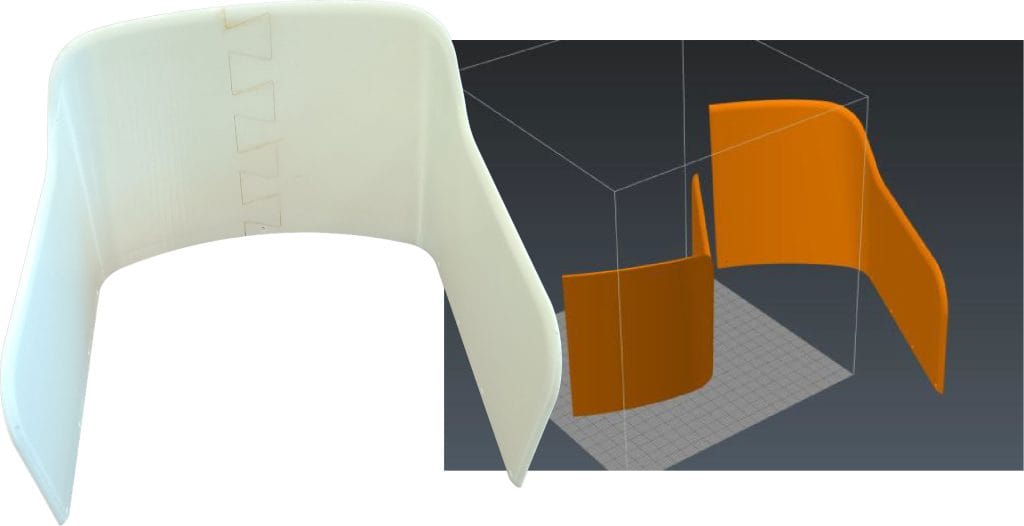
1. Component Dimensions and Slicing Strategy
The component occupied a bounding-box volume of approximately 108.4 liters, requiring careful slicer parameter selection to balance production time, mechanical performance, and dimensional stability.
The component was manufactured on the Omni TECH platform, utilizing ABS as the primary structural polymer and HIPS-20 as the sacrificial breakaway support material.
| Process Parameter | Technical Value | Engineering Justification |
| Primary Material | ABS | High impact strength, thermal resistance up to 100°C, and structural rigidity. |
| Support Material | HIPS-20 | Matching glass transition (Tg) profile; easily removed without damaging load-bearing interfaces. |
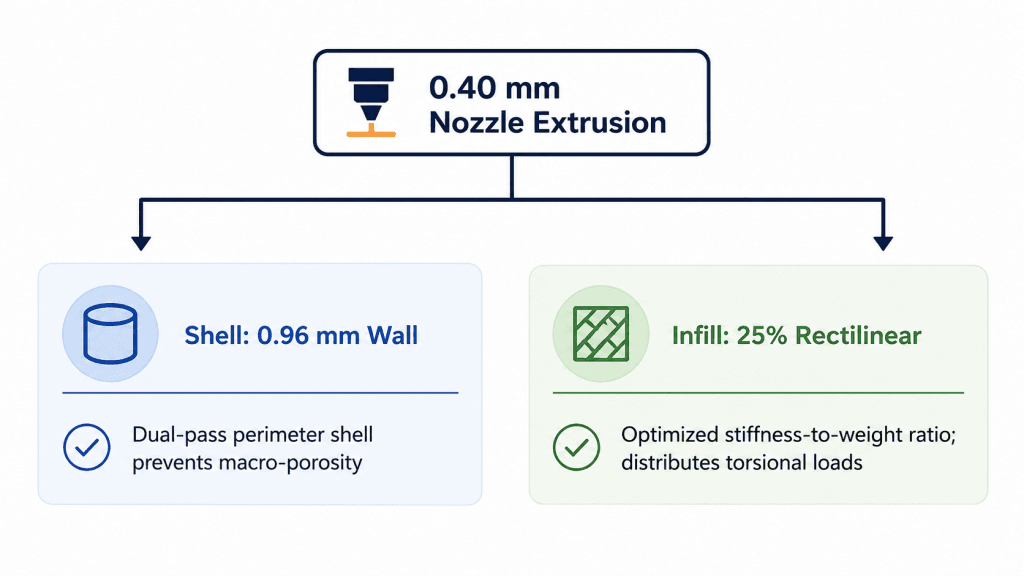
| Nozzle Diameter | 0.40 mm | Balances fine feature definition along joint interfaces with extrusion stability. |
| Layer Height (hL) | 0.20 mm | Optimizes z-axis resolution and minimizes inter-layer void formation. |
| Wall Thickness | 0.96 mm (2 Perimeter passes) | Ensures shell impermeability and sufficient flexural strength along load vectors. |
| Infill Topology | 25% Rectilinear | Provides balanced bidirectional internal support while limiting material consumption, component weight, and production time. |
| Total Print Time | 69 Hours | Continuous thermal deposition run under closed-loop control. |
2. Managing Thermal Stress and ABS Warpage
High-performance styrenic polymers like ABS exhibit a relatively high Coefficient of Thermal Expansion (α≈70–90×10−6 K−1). During a continuous 69-hour deposition cycle, cumulative thermal gradients across a 587 mm build footprint introduce significant internal tensile stresses:
σthermal=E⋅α⋅ΔT
Where E is the Young’s Modulus of the printed material, α is the Coefficient of Thermal Expansion (α≈70–90×10−6 K−1 for ABS), and ΔT is the temperature delta between the extrudate and the build enclosure environment. Uncontrolled cooling results in severe corner lifting (warpage) and layer delamination along the z-axis.
Process Solution: Active Chamber Heating and Bed Adhesion
To counteract these thermal stress vectors, the Omni TECH setup maintained strict thermal equilibrium:
- Chamber Temperature: Active thermal management held at 70°C, keeping the part just below the polymer’s glass transition temperature (Tg≈105°C), which prevents premature relaxation while mitigating stress concentration.
- Bed Temperature: Maintained at 100°C throughout the build.
- First-Layer Interface: ASNARE 3D Printing Adhesive was applied to the build plate. ASNARE creates a high-shear chemical bond that resists the upward thermal shear vectors exerted by the outer cooling perimeters oflarge-format ABS 3D printing components. Upon completion and cooling below 40°C, the adhesive interface cleanly releases the part without inducing mechanical stress on the base geometry.
- Key Takeaway for Process Engineers: For large-format ABS 3D printing structural parts exceeding 500 mm in length, passive heated enclosures are insufficient. Active thermal control (70°C chamber / 100°C bed)paired with laboratory-validated bed adhesives like ASNARE is required to guarantee dimensional accuracy within ±0.2 mm.
3. Cost Analysis & AM Unit Economics
Evaluating additive manufacturing for end-use functional components or pre-series product validation requires examining the total cost of ownership (TCO) against traditional manufacturing setup costs.
Direct Cost Breakdown (Silence Chair Fragment)
Below is the certified financial invoice summary for the 69-hour manufacturing run executed for Furnsolutions:
| Line Item | Expense (EUR) | Description / Notes |
| CAD Modeling & Slicing Preparation | €42.32 | CAD adjustment, seam placement, support placement engineering. |
| Bonding & Post-Processing Setup | €58.78 | Precision joining of multi-segment sub-assemblies and surface prep. |
| Machine Time & Material Consumption | €561.74 | Includes 69h machine run time, ABS filament, HIPS-20 support, and power consumption. |
| Total Net Cost | €662.85 | Turnkey, functional full-scale component. |
Additive Manufacturing vs. Traditional Tooling
To contextualize this project’s unit economics, consider the alternative: producing a low-volume run of large, complex furniture fragments via conventional aluminum tooling.
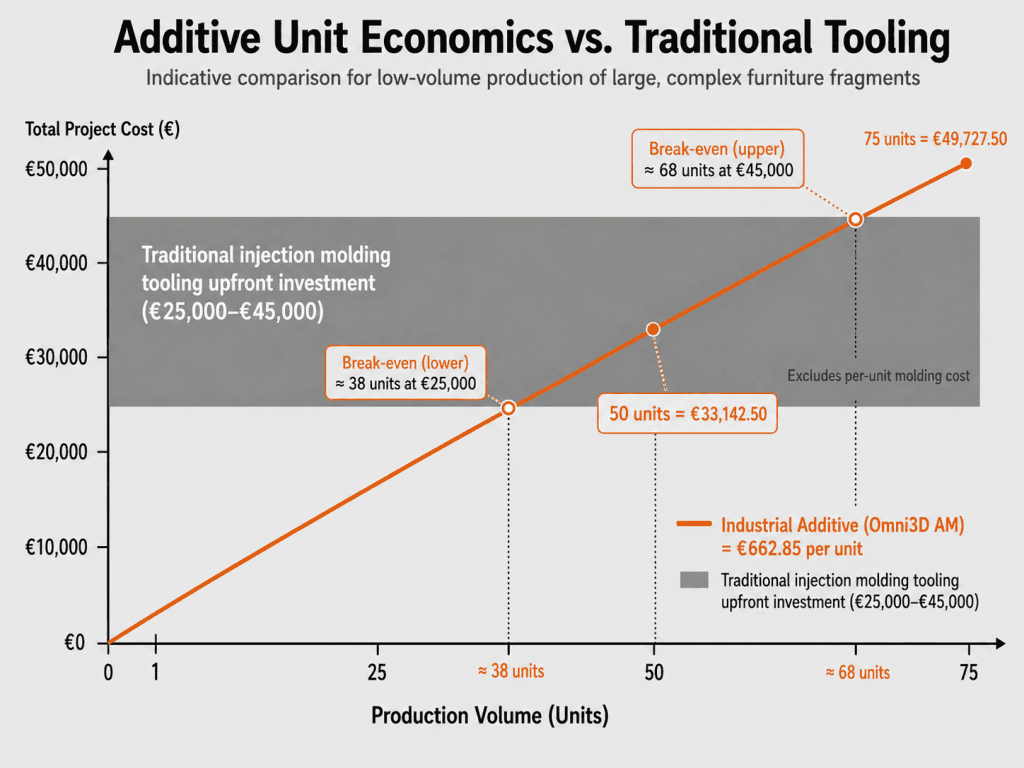
- Capital Expenditure Risk: An injection mold for a part of these dimensions (587×550×335 mm) carries a tooling investment of €25,000 to €45,000.
- Lead Time Compression: Tool fabrication requires 8 to 14 weeks. The Omni TECH platform produced the complete physical part in 69 machine hours, with total turnaround under 5 business days.
- Design Iteration Flexibility: Modifying structural ribbing or wall thickness in CAD costs zero tooling modification capital. The CAD setup fee for this build was just €42.32.
4. Engineering Guidelines for Large Structural Parts
When scaling B2B additive manufacturing for large structural components in industrial design and furniture engineering, keep these parameters in mind:
- Plan for Anisotropy: Z-axis tensile strength in FDM is typically 15–20% lower than X/Y strength due to inter-layer bond interfaces. Align major bending moments along the X/Y printing plane.
- Match Support Profiles: Utilizing a secondary extrusion head with dedicated support polymers (e.g., HIPS-20 for ABS) maintains structural integrity across large overhanging spans without damaging surface cosmetics during removal.
- Control Chamber Environment: Heated print beds alone cannot prevent warpage on builds over 300 mm. Maintain a minimum chamber temperature of 70°C for engineering thermoplastics like ABS.
A related furniture application can be found in our case study on large-format ABS 3D printing for office chair development, which examines how Orsa Proje accelerated its design and validation workflow.
For inquiries regarding industrial additive manufacturing services, material datasheets, or custom application engineering, contact the Omni3D technical team at printroom@omni3d.net or visit furnsolutions.com to learn more about furniture design solutions.







