
In-house 3D printing becomes worth evaluating when a manufacturer has recurring, suitable work and the people, process controls and capacity to produce it reliably. Frequent orders are a useful signal, but the investment decision should compare the cost and availability of accepted parts across outsourced, internal and hybrid production.
For many teams, industrial 3D printing services are the starting point. They make it possible to test a material, validate a design and understand finishing requirements before buying equipment. Those projects can also provide the evidence needed to decide whether ownership is the next step.
What changes with in-house 3D printing?
Owning a printer gives the production team direct control over scheduling, process development and engineering changes. It also brings responsibility for material handling, machine maintenance, operator training and part inspection.
The strongest candidates for internal production are usually defined families of work: recurring fixtures, repeated prototype iterations or a set of approved low-volume parts. A collection of unrelated jobs with very different material and process requirements may still be better served externally.
The decision is therefore about an operating capability. Define which work will move inside, who will run it and how the factory will know that the resulting parts are fit for use.
Five signals that justify a closer look
Recurring demand. Review actual orders and upcoming projects. Separate committed demand from possible future applications. Estimate machine hours as well as part counts, because a small number of long builds can occupy substantial capacity.
Frequent design changes. If engineering repeatedly waits for samples or fixture revisions, local scheduling may help. Measure the entire iteration cycle, including design, preparation, printing, finishing and evaluation.
A stable material and geometry range. A repeatable application family is easier to match to equipment and procedures than a constantly changing mix. Check the required build space, material grades, support strategy and finishing equipment.
Available ownership. Name the people responsible for the printer, process files, maintenance and acceptance decisions. Access to equipment is not the same as having staffed production capacity.
A measurable operational benefit. Examples include fewer external orders, reduced transport, shorter engineering queues or more predictable access to tools. Record the baseline so those benefits can later be assessed.
Compare three production routes
| Route | When it deserves consideration | Responsibility retained internally |
|---|---|---|
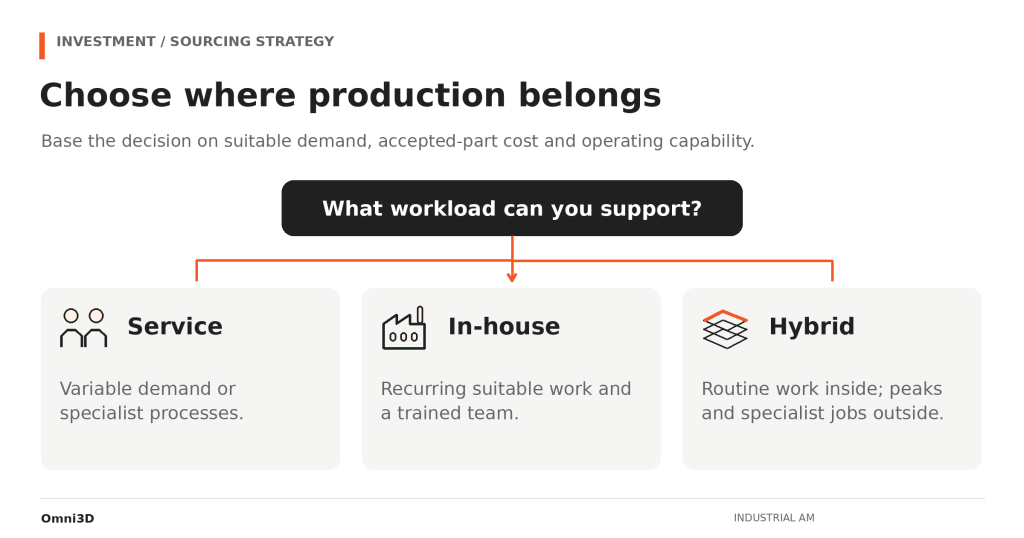
| External service | Intermittent demand, specialist processes or early feasibility work | Requirements, supplier coordination and acceptance |
| In-house production | Recurring suitable parts and an available operating team | Equipment, process control, materials, finishing and inspection |
| Hybrid model | A stable core workload with occasional peaks or specialist jobs | Routing decisions and consistent acceptance criteria |
A hybrid model can move routine tooling inside while keeping unusual materials, additional capacity or selected metal jobs with a service provider. It also provides a practical transition while the internal team develops experience.
Build a cost model around accepted parts
Start with the external cost of parts delivered to the required condition. Include finishing, inspection, transport and any recurring order charges. Compare that with internal production at the same specification and acceptance level.
For the internal route, include equipment and installation, training, maintenance, software where applicable, utilities, labour, consumables, post-processing and inspection. Account for failed builds and rework. Useful capacity should reflect actual availability rather than an assumption that the printer runs continuously.
NIST’s review of additive manufacturing costs provides a useful economic framework and explains why cost competitiveness depends on the application. It is background research, not a source of current machine prices or a forecast for an individual factory.
For one reasonably consistent part family, a simplified annual break-even model is:
Break-even accepted quantity = annual incremental fixed cost ÷ (outsourced cost per accepted part − internal variable cost per accepted part).
Use this relationship only when the cost difference in the denominator is positive and the required quantity fits the available production capacity. Define which fixed costs include an annual capital charge. Do not count the same equipment investment again in another line of the annual comparison.
For a mixed workload, model each part family and combine the required machine and operator hours. Keep cash payback separate: compare the initial investment with annual net cash savings, allowing for ramp-up, service costs and the cash costs of maintaining production.
Match the system to the applications
Build the equipment shortlist from the approved workload. For engineering-polymer tooling, compare configurations such as Omni TECH+ and Omni PRO against the required materials, geometry and process environment.
Where higher-temperature processing is needed, Omni PRO HT provides a different thermal capability. Exact material-grade profiles and finished-part requirements still need to be reviewed for the application.
For components that require metal, the Omni M150 and Omni M280 LPBF portfolio offers a separate technology route. Laser powder bed fusion (LPBF) investment planning must include powder handling, facility requirements, post-processing and inspection as well as the machine itself. Polymer and metal workflows should have separate capacity and cost assumptions.
Move from a successful sample to a repeatable workflow
Choose a small group of representative parts for the evaluation. Record the accepted drawing, material, production settings, finishing route, inspection method and total effort. Use those results to test the business case rather than relying on a demonstration print alone.
Agree how the process will transfer from the service provider to the internal system. Changes in equipment, settings or finishing may require further validation. Keep an external route available where it serves a defined operational need.
Data governance also remains part of ownership. Local printing can reduce some external file transfers, but access rights, backups, update paths and network configuration still need to be managed.
Discuss your application with Omni3D. Bring a representative part list, annual demand, current supplier costs and the operating requirements. Start with a service evaluation, an equipment assessment or a combined plan according to the evidence.







