

EN 45545-2 certified 3D printing is essential for manufacturers producing components for railway vehicles. A flame-retardant or approved filament does not automatically guarantee that the finished 3D printed part will meet railway fire-safety requirements. Printing parameters, component geometry, post-processing, adhesives, and coatings can all affect the final fire behavior of the component.
Material Approval vs. Finished Print Certification

A common misunderstanding in the market today is that a non-flammability approval of the material (filament) automatically translates to a non-flammability approval of the printout. This is fundamentally incorrect.

The process of 3D printing: including the specific printer, parameters, post-processing, and even the geometry of the part, can significantly alter the material’s flammability characteristics.
Therefore, a certificate covering only the raw filament is not sufficient to demonstrate compliance of the finished 3D printed component for railway use. Railway manufacturers and operators generally require documented compliance for the finished component before approving it for installation.
Are you attending InnoTrans 2026? Meet Omni3D in Berlin from 22–25 September in Hall 1.1, Stand 120, and discover our certified additive manufacturing solutions for railway applications.
Understanding EN 45545-2 for Railway Components
Every railway vehicle operating under the UIC (International Union of Railways) standards must strictly comply with comprehensive non-combustibility standards, specifically EN 45545-2. This European standard for fire protection of railway vehicles outlines strict requirements for the fire behavior of materials and components.
- Certification Authority: The EN45545 certificate of non-flammability is issued by certification bodies, so-called accredited laboratories, following rigorous testing of the actual 3D printed part, not just the raw filament.
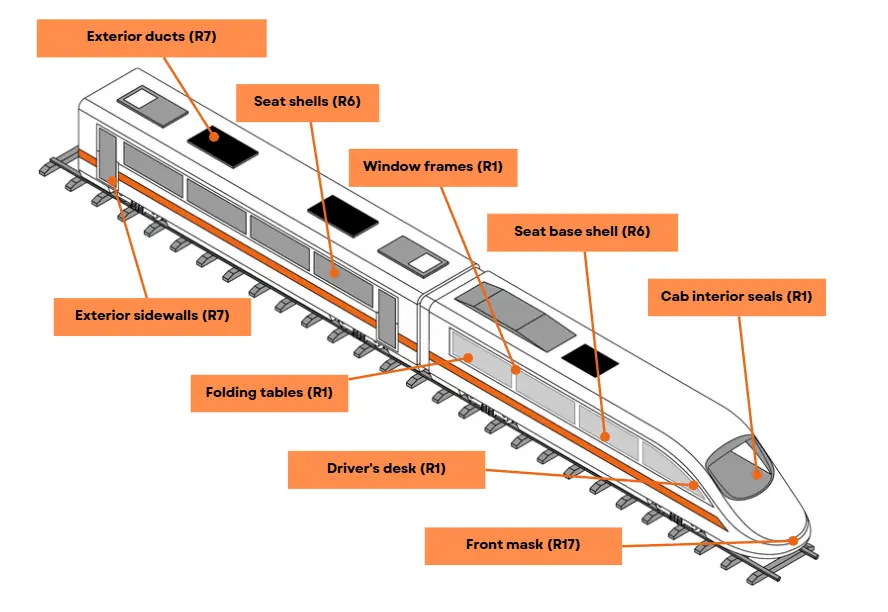
- Scope of Approval: The approval applies to specific hazard levels (HL1, HL2, HL3) and defined application areas (R1, R2, R6, R7, R17, R22, R23, R24, R25, R26). This detailed categorization ensures components meet the exact safety profile required for their intended use within a railway vehicle.
- Mandatory Compliance: Omni3D provides to all of our railway customers a non-combustibility certificate for the printed part, confirming its compliance with these stringent safety protocols.
There are rare exceptions where certification is not mandatory, such as for very small printed items (e.g., up to 60 grams for in-vehicle printouts, up to 200 grams for printouts outside the vehicle), but only if they are used in an already non-flammable environment, which is highly uncommon in most practical scenarios.
Download our brochure on railway
Why Certified 3D Printed Parts Are Essential
For companies engaged in railway vehicle interior parts 3D printing or any component destined for rail use, ensuring flame retardant 3D printing materials result in certified 3D prints for rail is not just a preference; it’s a regulatory and safety imperative. Without this final certification of the printed component, parts, regardless of material quality, cannot be legally or safely installed.
Omni3D Solutions for Railway Additive Manufacturing
Omni3D’s focus aligns precisely with the railway sector’s most stringent demands. Our interest is exclusively in enabling manufacturers to achieve EN45545 non-combustibility approval for the final 3D print. We understand that manufacturers are often approached with materials lacking this crucial final certification, which is why we emphasize transparency and compliance from the outset.
Our approach centers on providing industrial 3D printing solutions that not only offer design flexibility and optimization of the production process but, critically, guarantee the safety approvals necessary for the railway environment.
Benefits of Certified Railway 3D Printing
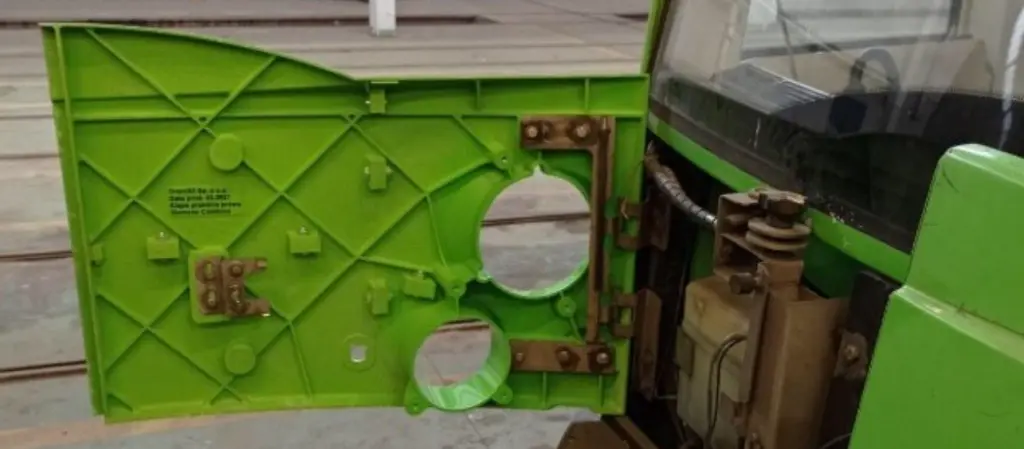
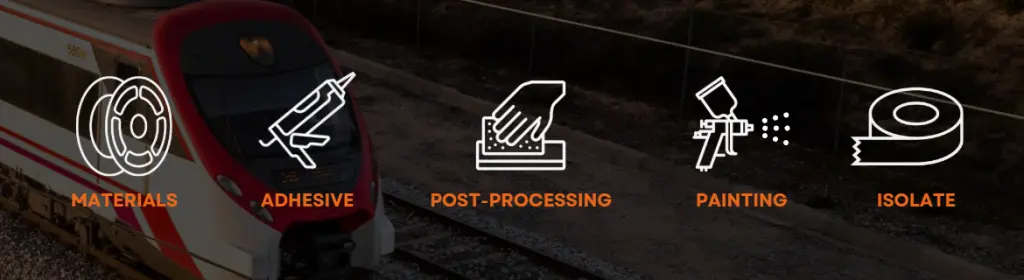
- Guaranteed Safety Approvals: All our 3D prints undergo rigorous testing to secure non-flammability certificates at the demanding HL3 R1 and HL3/R6 levels. This certification encompasses not just the raw print, but also glued and painted elements, ensuring comprehensive usability in the demanding interiors of railway cars.
- Unmatched Design Flexibility: Our industrial 3D printers facilitate the rapid creation of prototypes and the production of highly customized parts. This capability allows for quick adaptation to individual design needs, accelerating innovation cycles while adhering to strict UIC compliance 3D printing requirements.
- Optimization of the Production Process: By leveraging industrial 3D printing for rail, our solutions enable the efficient production of parts with complex geometries. This leads to significant material optimization and cost reduction, all while maintaining high strength and full compliance with international standards for additive manufacturing safety rail.
See our solutions
Learn more about Omni3D industrial solutions for Railway applications
Request a quote for 3D printed EN45545 compliant components
Meet Omni3D at InnoTrans 2026
Omni3D will be exhibiting at InnoTrans 2026, taking place from 22–25 September 2026 in Berlin, Germany.
Visit us in Hall 1.1, Stand 120 to discover how certified additive manufacturing can support railway manufacturers with compliant interior components, replacement parts, tooling, and low-volume production.
Our team will be available to discuss your railway applications, material requirements, and the importance of obtaining EN 45545-2 certification for the final printed component—not only for the raw filament.
Meet Omni3D at InnoTrans 2026
22–25 September 2026
Berlin, Germany
Hall 1.1, Stand 120
Conclusion: Reliable and Compliant Additive Manufacturing for Railways
The promise of industrial 3D printing for rail is immense, offering unprecedented capabilities for custom railway components 3D printing and optimized railway production. However, genuine value in this sector is intrinsically tied to certified safety. For railway manufacturers and operators, selecting a partner who understands and delivers on the critical distinction of EN 45545-2 approval for the final 3D print is essential.
Omni3D is committed to providing reliable, certified solutions that meet the highest safety standards, enabling you to confidently implement additive manufacturing for critical railway applications.







