
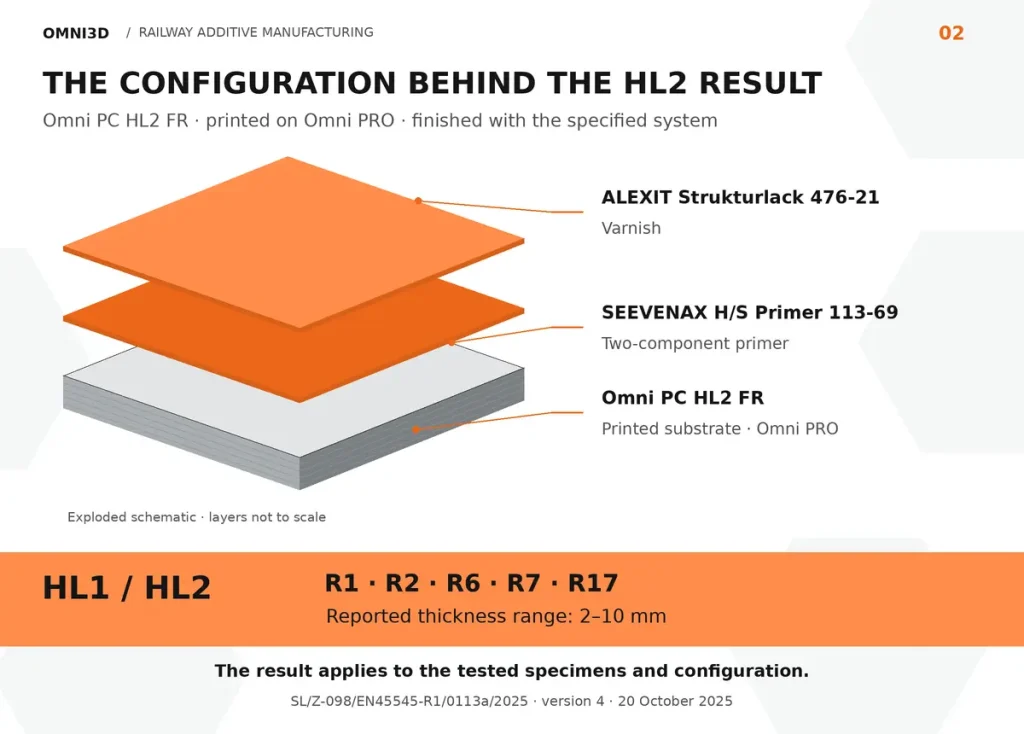
For railway additive manufacturing, EN 45545-2 HL2 performance must be considered in the context of the tested material, manufacturing process and surface finish. Omni3D’s documented example combines Omni PC HL2 FR, printing on an Omni PRO, and a specified primer-and-varnish system. The tested specimens fulfilled requirements R1, R2, R6, R7 and R17 at HL1 and HL2 within the reported 2–10 mm thickness range.
For maintenance, repair and overhaul (MRO) teams, this provides a concrete starting point for evaluating replacement components. The practical task is to match the intended part to the available evidence, then define a repeatable production and acceptance process.
What EN 45545-2 HL2 means for a railway component
EN 45545-2:2020+A1:2023 addresses the fire behaviour of materials and components used in railway vehicles. Its scope includes fire-related characteristics such as flame spread, smoke and toxic gases.
A hazard level and a requirement set need to be read together. Before choosing a polymer, establish the applicable requirements for the component and its installation with the responsible railway engineering team. A material name or an “FR” designation alone does not establish suitability for a particular railway application.
For an MRO project, define the part’s location, function, geometry, thickness and final finish at the start. These details connect material selection to the evidence needed for the intended use.
The documented Omni PC HL2 FR configuration
Sychta Laboratory report SL/Z-098/EN45545-R1/0113a/2025, version 4 dated 20 October 2025, records a tested configuration using Omni PC HL2 FR printed on an Omni PRO. The specified finishing system forms part of that configuration.
| Element | Documented configuration |
|---|---|
| Printing process | 3D-printed specimens produced on Omni PRO |
| Filament | Omni PC HL2 FR |
| Primer | Two-component SEEVENAX H/S Primer 113-69 |
| Varnish | ALEXIT Strukturlack 476-21 |
| Reported thickness range | 2–10 mm |
| Standard | EN 45545-2:2020+A1:2023 |
| Requirement sets | R1, R2, R6, R7 and R17 |
| Hazard levels fulfilled | HL1 and HL2 |
The report’s scope is limited to the tested specimens. It does not automatically establish compliance for other components, even when their material or appearance is similar. Its value is the documented combination of printing and finishing conditions that an engineering team can assess against a proposed application.
Include the surface finish in the qualification plan
For a painted railway part, specify the complete surface system before production trials. The reported Omni3D configuration includes both the SEEVENAX primer and the ALEXIT varnish. Treating those materials as interchangeable would move the project away from the documented configuration.
If a replacement panel requires an adhesive joint, filler or a different coating, include that change in the technical assessment. The report summarized here does not establish qualification of an adhesive or a bonded assembly.
Existing test evidence can support the qualification discussion. Whether it is sufficient for a proposed part, or whether additional evaluation or testing is needed, depends on the application and the scope accepted by the responsible parties.
Compare materials by the evidence available
The material portfolio should be evaluated by exact grade and documentation. A printed-and-finished specimen report, a material technical data sheet (TDS), and a system brochure provide different kinds of information.
| Material | Documented basis | Application assessment |
|---|---|---|
| Omni PC HL2 FR | Printed-and-finished configuration tested at HL1/HL2 for R1, R2, R6, R7 and R17; reported thickness range 2–10 mm. | Compare the intended part with the tested Omni PRO, material and finishing configuration. |
| Omni ABS Rail EN 45545 | The material TDS states that the ABS V0 resin can meet R22 and R23 at HL1 and HL2. | Keep this as a material-level statement and assess the resulting printed component separately. |
| PEI-9085 | Omni3D railway system documentation discusses this material with Omni PRO HT. | Obtain the exact grade’s report and confirm the applicable requirement set, hazard level and configuration. |
When an application requires HL3, request evidence that covers that level and the relevant requirement set. The PC HL2 FR report described above establishes an HL1/HL2 result; it does not establish HL3.
Thermal capability and process selection
An actively heated chamber is one of the process capabilities to consider when selecting an industrial Fused Filament Fabrication (FFF) system. Compare the machine’s available temperature range with the requirements of the exact material and qualified manufacturing process.
The current Omni TECH+ has a maximum active chamber temperature of 80°C. Omni PRO reaches 140°C, while Omni PRO HT reaches 220°C. These values describe machine capability, not the printing temperature used in the cited HL2 test. The three systems can be compared in the Omni3D industrial printer range.
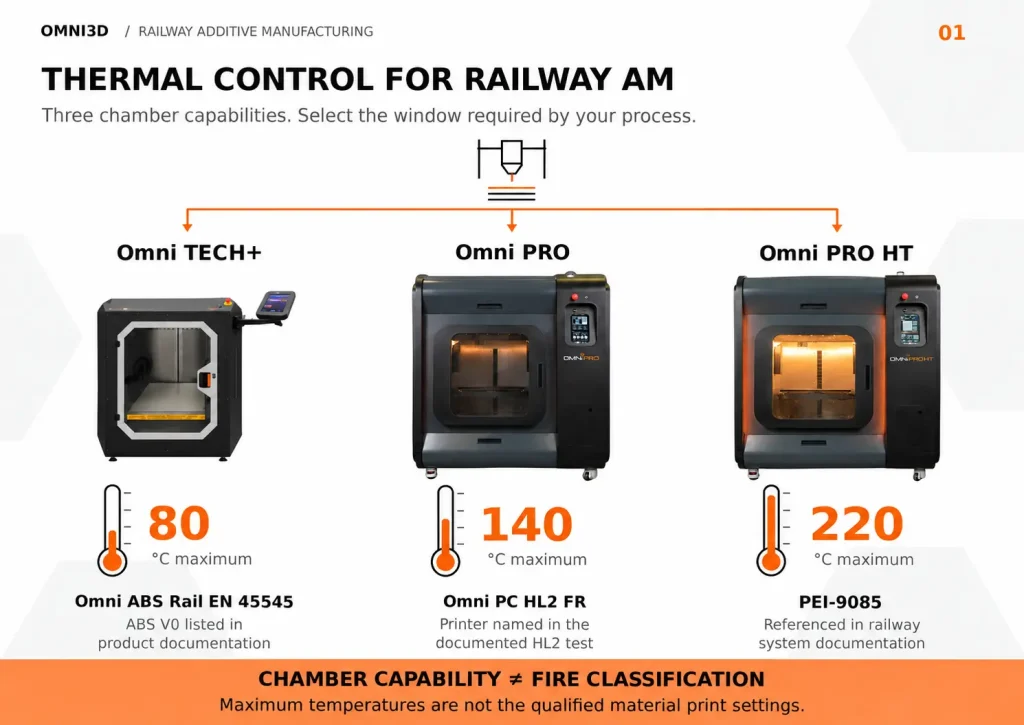
Omni TECH+ documentation lists ABS V0 among its materials. Omni PRO is the machine named in the PC HL2 FR test configuration. PEI-9085 appears with Omni PRO HT in railway system documentation. Each association needs to retain its own evidence scope; a higher maximum chamber temperature does not establish a higher fire-performance classification.
Build an MRO qualification plan around the component
Interior covers, access panels, passenger amenity parts and technical housings are possible candidates for assessment. Their function and installation must determine the requirements. Avoid assigning an R classification simply from a broad label such as “panel” or “bracket.”
Define the application
Record the part’s location, dimensions, operating conditions, loads, interfaces and surface finish. Confirm the applicable hazard level and requirement set before selecting a material configuration.
Document the manufacturing configuration
Identify the exact material grade, printer, approved process settings and finishing products. Retain the relevant reports alongside the production specification so changes can be assessed against a clear baseline.
Agree on acceptance before production
Review how the test evidence applies to the proposed component. Address dimensional and functional checks, mechanical requirements and any further fire-performance assessment with the responsible engineering and approval teams. A documented fire-test result supports this work but does not establish every aspect of service suitability.
Discuss your railway application with Omni3D
Share your target part, required hazard level and requirement set, thickness range, finish and production volume. Discuss your application with Omni3D to review the material, printer configuration and validation work needed for your railway MRO project.







