
How to Achieve a Clean Surface Without Damage
Flexible materials like TPU open up a wide range of industrial applications, from cushioning elements to gaskets and protective covers. At the same time, TPU brings a practical challenge that shows up quickly in real production work: supports are often difficult to remove cleanly. When TPU supports are removed mechanically, details can stretch, surfaces can tear, and the final part can lose the aesthetic quality that many functional components still require.
At Omni3D, we tested an approach that is simple, widely accessible, and often effective in industrial FFF workflows: printing TPU with PLA used as the support material. The goal is not to “hack” the process, but to achieve a reliable separation method that avoids surface damage and reduces post-processing effort.
Why TPU printing is challenging
TPU is a thermoplastic polyurethane known for flexibility, abrasion resistance, and impact resistance. Those same properties make it attractive for industrial production, but they also make printing and finishing more demanding. Because TPU is flexible, it is more susceptible to deformation during printing, and feeding it through an extruder can be more difficult than rigid materials. Support removal becomes even more challenging when supports are printed in the same flexible material, since the support structures can stretch rather than snap cleanly.
In practice, mechanically removing TPU supports can leave marks, deform edges, and pull on small features. For parts with enclosed spaces or visually sensitive surfaces, this can turn a technically correct print into an unacceptable finish.
Why PLA works as a support material for TPU
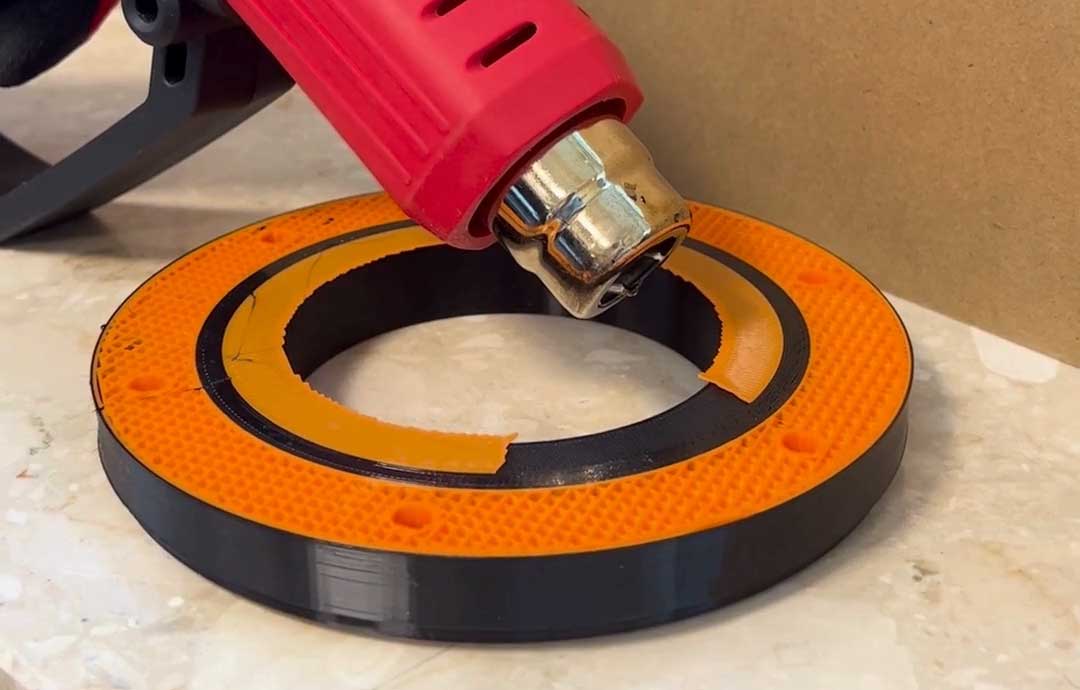
The first reason is thermal behavior. PLA softens at a lower temperature than the point at which TPU begins to degrade. Under controlled heat, for example with a heat gun, PLA loses rigidity and stops “holding” onto the TPU surface. This creates a more forgiving separation process, where supports can be removed without tearing, and the TPU surface can remain intact, without aggressive scraping or cutting.
A second reason is material interaction. PLA and TPU do not form a permanent chemical bond, which supports stable printing during the build and cleaner separation afterward.
There is also a geometric advantage. PLA is rigid, so it provides stable support for a flexible material while layers are being formed. This improves geometric control, reduces the risk of deformation, and increases repeatability, which matters when the same part must be produced consistently, not just once.
Finally, PLA can be a practical alternative to soluble support materials. Soluble materials such as PVA or BVOH often require controlled storage humidity, additional time for dissolution, and generate post-processing waste. PLA is easier to store, typically more predictable in printing, and can be cost-effective in industrial settings.
How the separation process works
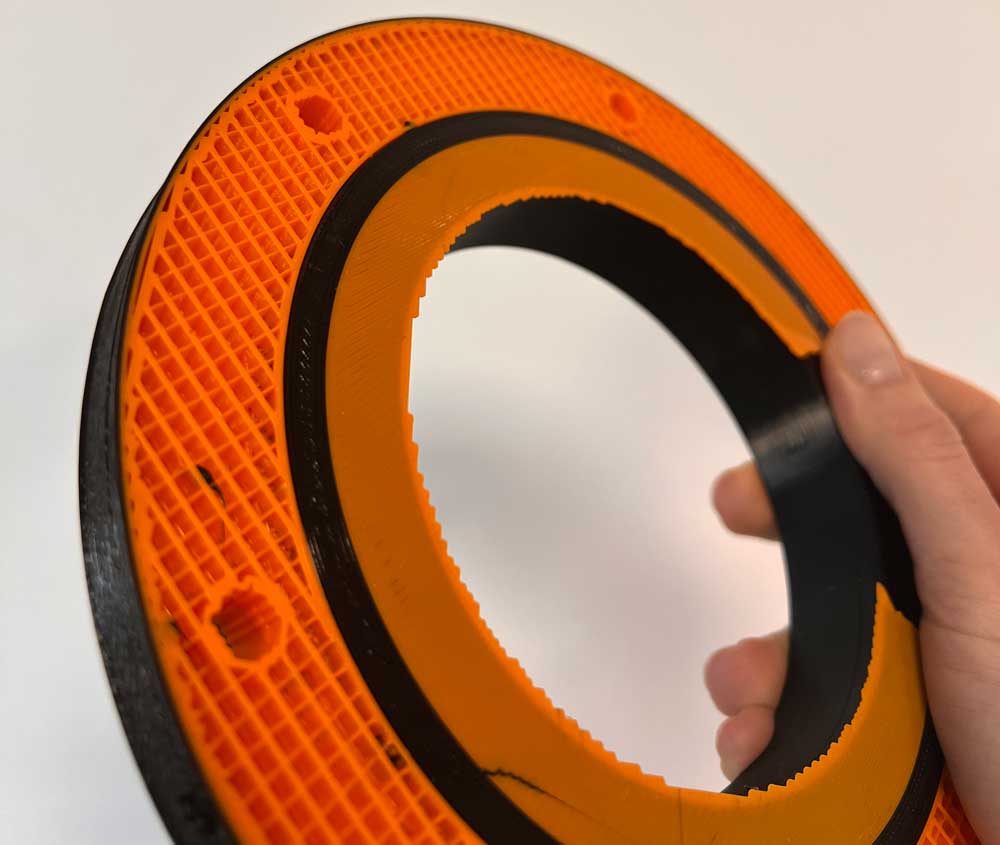
The process starts with a dual-material print in FFF technology, using TPU for the part and PLA for the supports. After printing, controlled heating is applied so the PLA support softens and loses rigidity. Once softened, the support separates more easily, allowing a cleaner surface finish on the TPU.
The key requirement here is temperature control. Heating must be sufficient to soften PLA, but not so aggressive that the TPU part overheats or deforms. When done correctly, the result is a clean, undamaged TPU surface without heavy mechanical post-processing.
When this solution makes the most sense
TPU with PLA support is particularly useful when the printed part has enclosed spaces where support removal is difficult, or when details and surface aesthetics matter. It also fits well in short production runs and functional prototyping, where speed, repeatability, and predictable post-processing are just as important as the print itself.
In industrial environments, process stability is often the deciding factor. The ability to repeat the same workflow reliably and scale it across runs can be more valuable than a theoretically perfect method that is sensitive to storage conditions or slow in post-processing.
Limitations to keep in mind
Like any manufacturing method, this approach requires validation. It depends on proper dual-extruder configuration, practical testing of temperature parameters, and controlled post-processing. It is not a universal solution for every project, but in many cases it provides an effective and economical alternative to soluble supports, while maintaining surface quality and reducing the risk of damage.
Technical note
This method works best when the dual-extruder setup is well-tuned and the support interface is configured for clean breakaway after softening. A short test print is recommended to verify separation behavior on your specific geometry before running a full batch. During removal, apply heat gradually and keep it localized on the support material to avoid overheating the flexible part.
Summary
Using PLA as a support for TPU in FFF technology is a practical method for achieving clean surfaces without mechanical damage. It can improve finishing results, increase process stability, and reduce cost and complexity compared to soluble supports, especially in industrial workflows where predictability and scalability matter.
If you are working on flexible parts and want a robust approach that can be implemented in real production conditions, TPU with PLA support is worth considering.
FAQ
Why can TPU supports damage the surface?
Because TPU is flexible, supports can stretch and pull on details during removal, leaving marks or deforming edges.
Why does PLA separate more cleanly from TPU?
PLA softens under controlled heat and does not form a permanent bond with TPU, which helps supports detach without tearing the flexible surface.
Is this better than soluble supports like PVA or BVOH?
It can be, especially when storage humidity, dissolution time, and post-processing waste are concerns. PLA is often easier to store and more predictable in printing.
What is the most important rule during removal?
Control the temperature carefully. The goal is to soften PLA without overheating the TPU part.







